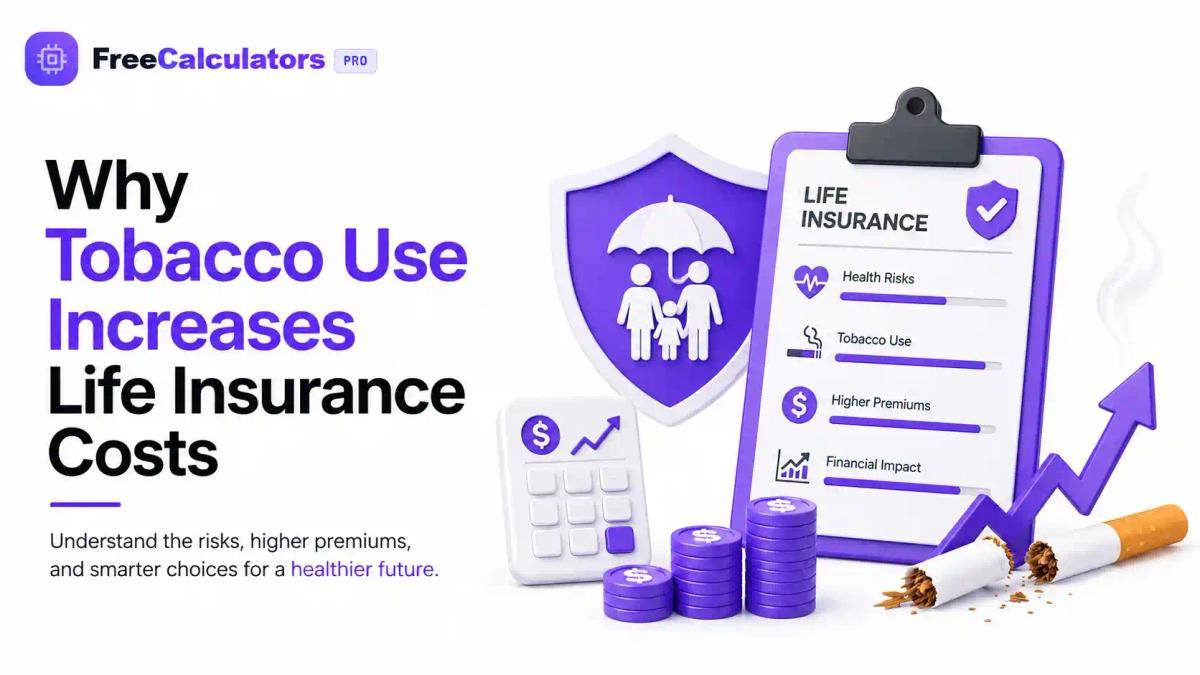
Tobacco use increases life insurance costs because insurers classify smokers and other nicotine users as higher mortality risks. Tobacco is linked to heart disease, cancer, and respiratory illness, so insurers charge higher premiums — often 2 to 3 times more than non-smoker rates — to offset the statistically shorter life expectancy and higher claims risk associated with tobacco use.
Introduction
If you've ever compared life insurance quotes as a smoker versus a non-smoker, you've probably noticed a jarring difference in price. It's not a coincidence, and it's not arbitrary — it's math. Insurance companies build their pricing on decades of mortality data, and that data consistently shows that tobacco users face higher health risks than non-users.
This guide breaks down exactly why tobacco use and life insurance costs are so closely linked, how underwriting actually works behind the scenes, what counts as "tobacco use" in the eyes of an insurer, and — most importantly — what you can do to lower your premiums, whether you currently use tobacco or you've already quit. Along the way, we'll point you toward free tools, like the life insurance calculator, that can help you estimate costs before you ever talk to an agent.
What Counts as "Tobacco Use" in Life Insurance?
Most people assume "tobacco use" just means cigarettes. In reality, insurers cast a much wider net. When you apply for life insurance for smokers — or any policy, really — you'll typically be asked to disclose use of:
- Cigarettes
- Cigars and pipe tobacco
- Chewing tobacco and smokeless tobacco
- Nicotine gum and nicotine patches
- Vaping and e-cigarettes (even nicotine-free, in some cases)
- Nicotine pouches
Many applicants are surprised to learn that vaping and life insurance premiums are connected in the same way cigarettes are. Even though e-cigarettes don't involve combustion, most insurers still classify regular vapers using nicotine as tobacco users, because nicotine dependency itself carries health implications and because vaping is still a relatively new field for long-term mortality data.
Why Tobacco Use Increases Life Insurance Costs
At its core, life insurance underwriting is a pricing exercise built on risk. Insurers use actuarial tables — statistical models built from mortality data across millions of policyholders — to estimate how long someone is likely to live. Tobacco use shifts those estimates significantly.
1. Higher Mortality Risk
Tobacco use is strongly associated with cardiovascular disease, lung cancer risk, chronic obstructive pulmonary disease (COPD), and other chronic illness. According to the Centers for Disease Control and Prevention (CDC), smoking remains one of the leading preventable causes of death in the United States. Insurers price policies around this reality, which is why smoker insurance rates run higher than non-smoker rates across nearly every carrier.
2. Actuarial and Mortality Tables
The Society of Actuaries and individual insurance companies maintain detailed mortality tables that separate smokers from non-smokers. These tables show that, on average, tobacco users have a shorter life expectancy than non-users of similar age and health profile. Since a life insurance payout — the death benefit — is triggered by the policyholder's death, a shorter expected lifespan means the insurer expects to pay out sooner, which requires higher premium collection to balance the risk pool.
3. Premium Loading
When an applicant discloses tobacco use, insurers apply what's known as premium loading — an additional cost layered onto the base rate to account for elevated risk. This is why tobacco insurance premium costs for a healthy 40-year-old smoker can easily run two to three times higher than the same coverage for a non-smoker.
4. Underwriting Classification
Insurers sort applicants into underwriting classes such as Preferred Plus, Preferred, Standard Plus, and Standard — and then apply separate smoker versions of each class. A "Preferred Smoker" will still pay considerably more than a "Standard Non-Smoker," even though both are in relatively good health, simply because of the tobacco classification attached to their file.
(If you want to see how these numbers play out for your own situation, FreeCalculators.tools offers a term life insurance calculator that lets you compare smoker and non-smoker scenarios side by side.)
How Insurers Classify Tobacco Users
Insurance companies don't just take your word for it when you check "non-smoker" on an application. Medical underwriting typically includes:
- A health questionnaire covering tobacco and nicotine use
- A cotinine test (urine, blood, or saliva) to detect nicotine metabolites
- Review of prescription history for nicotine replacement therapy
- MIB (Medical Information Bureau) database checks
- In some cases, a full medical exam
Cotinine testing is the industry standard for verifying tobacco use because cotinine — a byproduct of nicotine — can be detected in the body for days to weeks after use, making it far more reliable than a simple self-report.
Smoker vs. Non-Smoker Classification
| Factor | Non-Smoker Rate | Smoker Rate |
| Typical premium multiplier | 1x (baseline) | 2x–3x baseline |
| Underwriting class options | Preferred Plus to Standard | Preferred Smoker to Standard Smoker |
| Nicotine test required | Sometimes | Almost always |
| Tobacco-free period required for reclassification | N/A | Typically 12 months |
Does Vaping Count as Smoking for Life Insurance?
Yes, in most cases. Even though vaping and life insurance underwriting is a newer and evolving area, the majority of insurers still treat regular e-cigarette or vape use as tobacco use if nicotine is present. A small number of carriers have started to differentiate vapers from cigarette smokers with slightly better rate classes, but this is far from universal. If you vape and are shopping for coverage, it's worth comparing multiple carriers, since tobacco-friendly insurers vary widely in how they underwrite this category.
Do Cigars, Pipes, and Smokeless Tobacco Count Too?
Generally, yes — but with some nuance:
- Cigar smoking insurance: Occasional cigar smokers (commonly defined as fewer than 2–4 cigars per month) may qualify for non-smoker rates with some carriers, since cigar use isn't always inhaled the same way cigarettes are.
- Chewing tobacco insurance: Smokeless tobacco is almost always classified the same as cigarette use because nicotine absorption and long-term health risks are comparable.
- Pipe tobacco insurance: Similar to cigars — frequency and inhalation pattern often determine classification.
If you're an occasional or social smoker, it's worth asking an agent directly whether your usage pattern could still qualify for standard non-smoker underwriting.
Can You Lower Your Life Insurance Costs as a Tobacco User?
Yes — there are several practical, realistic ways to reduce smoker insurance premiums:
1. Quit and Wait Out the Tobacco-Free Period
Most insurers require 12 months of tobacco-free status before you can be reclassified as a non-smoker, though some require up to 24 months for the very best rates. If you've quit smoking, life insurance after quitting smoking is one of the most searched topics for a reason — the savings can be substantial.
2. Shop Around Across Multiple Carriers
Not all insurers price tobacco risk the same way. Some are notably more competitive for smokers than others. Comparing quotes from multiple life insurance providers — rather than accepting the first quote you receive — can meaningfully lower your cost.
3. Consider a Different Policy Type
Term life insurance tends to be more affordable for smokers than whole life insurance or universal life insurance, simply because term coverage is temporary and doesn't build cash value. If affordability is your main concern, starting with a whole life insurance calculator alongside a term quote can help you see the cost gap clearly.
4. Improve Other Health Factors
While tobacco use is a major factor, it's not the only one. Improving cardiovascular health, managing weight, and controlling other risk factors can sometimes offset a portion of the tobacco-related premium loading, depending on the insurer's rating system.
5. Ask About No-Exam Options
No medical exam life insurance for smokers does exist, though it typically comes at a higher price point than fully underwritten policies, since the insurer is accepting more uncertainty in exchange for a faster approval process.
Best Free Tools to Estimate Your Life Insurance Costs
Before speaking with an agent, it's worth running your own numbers. FreeCalculators.tools offers several free planning tools that make this easier:
- Life Insurance Calculator — estimate how much coverage you actually need
- Term Life Insurance Calculator — compare term lengths and coverage amounts
- Whole Life Insurance Calculator — see how permanent coverage costs compare
- Retirement Calculator — understand how life insurance fits into your broader retirement plan
- Mortgage Protection Calculator — estimate coverage needed to protect your home loan
- Budget Calculator — see how a monthly premium fits into your overall finances
- College Savings Calculator — plan coverage amounts that account for your children's future education costs
- Compound Interest / Savings Calculator — see how premium savings from quitting tobacco could grow if redirected into savings
These tools are free, require no signup, and can give you a realistic starting point before you request formal quotes.
Common Mistakes Smokers Make When Buying Life Insurance
- Lying about tobacco use. Misrepresentation on an application can lead to denied claims or policy rescission during the contestability period — insurers routinely verify with cotinine testing and prescription databases.
- Not shopping around. Accepting the first quote without comparison often means overpaying significantly.
- Ignoring the tobacco-free reclassification window. Many former smokers keep paying smoker rates simply because they never asked their insurer to reassess their status after quitting.
- Assuming vaping is treated like non-smoking. As covered above, this is rarely true.
- Choosing the wrong policy type. Locking into expensive whole life coverage when a more affordable term policy would meet the same need.
- Not disclosing occasional or social tobacco use. Even infrequent use can affect classification, and non-disclosure creates risk of future claim disputes.
Practical Examples
Example 1 — The Cigarette Smoker: A 45-year-old male smoker applying for a $500,000, 20-year term policy might pay roughly two to three times what a non-smoking counterpart in similar health would pay for identical coverage.
Example 2 — The Former Smoker: A 38-year-old who quit smoking 14 months ago and passed a cotinine test may now qualify for non-smoker rates, cutting their premium substantially compared to what they paid as an active smoker.
Example 3 — The Occasional Cigar Smoker: A 50-year-old who smokes cigars socially (fewer than four per month) applies with a carrier that offers a "cigar-only" underwriting niche and qualifies for a rate class close to standard non-smoker pricing — something a daily cigarette smoker would not achieve.
Future Trends in Tobacco Underwriting
The underwriting landscape is evolving quickly, driven by data and technology:
- AI underwriting is increasingly used to assess risk faster, incorporating broader health data beyond a simple tobacco checkbox.
- Wearable health data may eventually allow insurers to assess real cardiovascular and respiratory function rather than relying solely on self-reported tobacco use.
- Predictive mortality analytics are being refined to better differentiate between vaping, occasional tobacco use, and daily cigarette smoking — categories that are currently often lumped together.
- Digital medical exams and automated underwriting are shortening approval timelines, even for tobacco users.
- Expect insurers to continue refining nicotine screening methods and potentially introduce more nuanced classifications for reduced-risk nicotine products as more long-term data becomes available.
FAQ Section
Q1: Why do smokers pay more for life insurance? Smokers pay more because tobacco use is statistically linked to higher mortality risk from heart disease, cancer, and respiratory illness. Insurers use actuarial mortality data to price this added risk into premium loading, which is why smoker rates typically run two to three times higher than non-smoker rates for otherwise identical coverage.
Q2: Does vaping count as smoking for life insurance purposes? In most cases, yes. Insurers generally treat regular nicotine vaping the same as cigarette smoking during underwriting, even though the health data on vaping is newer. A small number of carriers offer distinct vaper rate classes, but this isn't yet standard across the industry.
Q3: How long after quitting smoking can I get non-smoker rates? Most insurers require 12 consecutive months of tobacco-free status before considering you for non-smoker rates, though some require up to 24 months for the best classifications. You'll typically need to pass a cotinine test to confirm.
Q4: Do cigars count as tobacco use in underwriting? Usually yes, though occasional cigar smokers (often fewer than 2–4 per month) may qualify for better rate classes with certain insurers, since cigar use is sometimes evaluated differently than cigarette use due to inhalation patterns.
Q5: What is a cotinine test, and why do insurers use it? A cotinine test detects a nicotine byproduct in blood, urine, or saliva. Insurers use it because cotinine remains detectable for days to weeks after tobacco use, making it a far more reliable verification method than simply asking applicants to self-report.
Q6: Can I get life insurance if I currently smoke? Yes. Smokers can still qualify for term, whole, or universal life insurance — they'll simply be placed in a smoker-specific underwriting class with higher premiums than non-smoker classes.
Q7: What happens if I lie about smoking on my application? Misrepresenting tobacco use can lead to a denied claim or policy rescission if discovered, particularly within the contestability period. Insurers routinely verify tobacco status through medical exams, cotinine testing, and prescription database checks.
Q8: Are nicotine patches or gum considered tobacco use? Nicotine replacement products can sometimes trigger tobacco classification since they indicate current or recent nicotine dependency, though policies vary by insurer. It's best to disclose their use and ask directly how a specific carrier handles it.
Q9: Is no-medical-exam life insurance available for smokers? Yes, no medical exam life insurance for smokers is available through several carriers, though it generally costs more than fully underwritten policies since the insurer accepts more uncertainty in exchange for faster approval.
Q10: How much more do smokers typically pay for life insurance? While it varies by age, health, and carrier, smokers commonly pay two to three times more than non-smokers for the same coverage amount and term length.
Key Takeaways
- Tobacco use increases life insurance costs because it raises statistical mortality risk.
- Insurers rely on actuarial tables, cotinine testing, and medical underwriting to classify tobacco users accurately.
- Vaping, cigars, pipe tobacco, and smokeless tobacco are generally treated similarly to cigarette smoking during underwriting.
- Smoker premiums typically run 2–3x higher than non-smoker rates for identical coverage.
- Quitting tobacco for 12+ months can qualify you for significantly lower non-smoker rates.
- Shopping across multiple insurers can uncover more competitive rates for tobacco users.
- Term life insurance is generally more affordable for smokers than whole or universal life insurance.
- Free tools like a life insurance calculator can help you estimate costs before applying.
Expert Summary
Life insurance pricing for tobacco users reflects real, data-driven mortality risk rather than arbitrary penalties. Insurers rely on decades of actuarial research showing that tobacco use — whether from cigarettes, cigars, smokeless tobacco, or vaping — correlates with increased risk of cardiovascular disease, cancer, and respiratory illness. This risk is verified through cotinine testing and medical underwriting, then priced through premium loading and smoker-specific rate classes. Tobacco users aren't excluded from coverage, but they typically pay more until they either quit and requalify as non-smokers or find a carrier with more favorable underwriting for their specific tobacco use pattern.
Conclusion
Understanding why tobacco use increases life insurance costs puts you in a stronger position as a shopper. Whether you currently use tobacco, vape occasionally, or quit years ago, the key to getting the best rate is knowing how underwriting works, being honest on your application, and comparing options across multiple carriers rather than settling for the first quote you receive.
Call to Action
Ready to see what your life insurance costs could actually look like? Head over to FreeCalculators.tools and try the free life insurance calculator to estimate your coverage needs and costs in minutes — no signup required. Explore our full library of insurance and financial planning tools, read more on our blog, or contact us if you have questions about planning your coverage the smart way.