Quick Answer
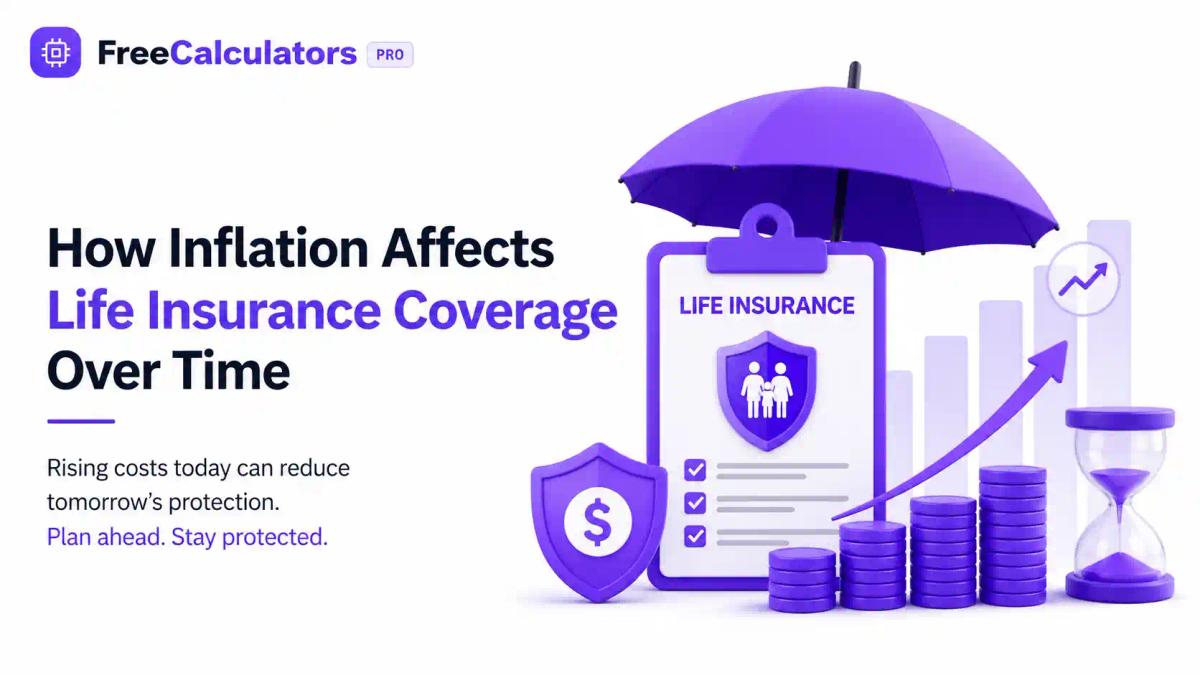
Inflation usually doesn't change the stated dollar amount of a fixed life insurance death benefit, but it steadily reduces what that benefit can actually buy. Over a 20–30 year policy, rising prices can shrink the real value of your coverage, which is why periodically reviewing and adjusting your policy matters just as much as buying it in the first place.
Introduction
If you bought your policy years ago and haven't looked at it since, there's a good chance the coverage that once felt more than enough now covers a lot less than it used to. That's the quiet, often-overlooked relationship between inflation and life insurance: the number on your policy stays the same, but the value of that number keeps shrinking. Before you decide whether your coverage still holds up, it's worth running your numbers through a life insurance calculator to see where you actually stand today. If you're comparing policy types, tools like the term life insurance calculator and the whole life insurance calculator on FreeCalculators.tools can help you model how coverage needs shift as costs rise. And if you haven't settled on a coverage amount yet, our earlier guide on how much term life insurance you need in 2026 is a useful starting point before diving into the inflation side of the equation.
This article walks through exactly how inflation affects life insurance coverage, why a fixed death benefit loses purchasing power, how to estimate what your policy will actually be worth years from now, and what you can do about it — from inflation riders to simple annual policy reviews.
How Inflation Affects Life Insurance
Inflation is the gradual rise in the price of goods and services, which reduces the purchasing power of a fixed amount of money over time. Life insurance doesn't escape this dynamic. A life insurance policy promises to pay a specific death benefit — say, $500,000 — regardless of when a claim is paid. That number is locked in at the time of underwriting and generally does not adjust upward just because prices have risen.
Here's the important distinction: inflation does not usually reduce the stated death benefit. It reduces what that fixed sum can purchase by the time your beneficiaries need it. A $500,000 payout in 2026 and a $500,000 payout in 2046 are the same number on paper, but they represent very different amounts of real financial protection.
Why a Fixed Death Benefit Loses Purchasing Power
Most term life insurance and many permanent life insurance policies pay a fixed, nominal amount. Because the death benefit doesn't move with the Consumer Price Index (CPI) or general cost of living, its real value — what it can actually buy in groceries, tuition, housing, or income replacement — declines every year prices rise.
This matters most for:
- Long policy terms (20–30 year term policies)
- Young policyholders locking in coverage decades before it may be needed
- Households relying on a single income for income replacement
- Families with large mortgage protection or education expenses needs
- Anyone who hasn't done a policy review in several years
How Much Will a $500,000 Life Insurance Policy Be Worth in the Future?
To understand real value, it helps to see the math. Using the formula:
Future purchasing power = Current amount ÷ (1 + inflation rate)ⁿ
Here's what happens to a $500,000 death benefit under different inflation assumptions:
| Annual Inflation | Value After 10 Years | Value After 20 Years | Value After 30 Years |
| 2% | ~$410,000 | ~$336,000 | ~$276,000 |
| 3% | ~$372,000 | ~$277,000 | ~$206,000 |
| 4% | ~$338,000 | ~$228,000 | ~$154,000 |
| 5% | ~$307,000 | ~$188,000 | ~$116,000 |
Even at a modest 3% average inflation rate, a $500,000 policy could be worth roughly the same as $277,000 in today's dollars after 20 years. That's a substantial coverage gap — and it's one reason financial professionals recommend running these numbers through an inflation-adjusted life insurance calculator before assuming your policy is "set and forget."
How to Calculate the Inflation-Adjusted Value of Life Insurance
To estimate your own inflation-adjusted death benefit, you'll need three inputs:
- Current death benefit — the coverage amount on your policy today
- Assumed annual inflation rate — often estimated using historical CPI averages published by the Bureau of Labor Statistics
- Number of years until the benefit might realistically be paid
Plugging these into the formula above gives you the real, present-day value of your future payout. This is exactly the kind of calculation a life insurance coverage calculator or inflation calculator is built for — rather than estimating by hand, it's faster and more accurate to model a few different scenarios online.
How Inflation Can Create a Life Insurance Coverage Gap
A coverage gap happens when your policy's real value falls below what your family would actually need to replace income, pay off debt, or cover future expenses. This gap widens when:
- Household expenses rise faster than your policy's fixed value
- Debt (mortgage, student loans) grows or isn't accounted for
- Children's education expenses, including college tuition, increase
- The policyholder never increases coverage despite rising cost of living
This is why coverage should be judged not just by the dollar amount, but by whether it still matches your family's future financial needs.
Factors to Consider When Calculating Future Coverage Needs
When estimating how much life insurance you need — with inflation factored in — consider:
- Income replacement for dependents
- Mortgage balance and other debt repayment
- Education expenses, including tuition (a college savings calculator or 529 calculator can help estimate future costs)
- Ongoing household expenses
- Final expenses, including funeral costs
- Existing savings and assets
- Expected inflation over the remaining policy term
Financial professionals often use a needs-based approach (sometimes called the DIME method — Debt, Income, Mortgage, Education) rather than a flat, one-time number, precisely because flat numbers lose relevance as prices rise.
Does Inflation Increase Life Insurance Premiums?
This is a common point of confusion. Inflation affects the economic value of your coverage — not necessarily your premium. Premiums are primarily determined by:
- Age at the time of purchase
- Health and underwriting classification
- Policy type (term vs. permanent)
- Coverage amount and policy length
Inflation can indirectly influence insurer pricing over the long run (through higher operating and claims costs across the industry), but it doesn't automatically raise the premium on an existing, locked-in policy the way it erodes the death benefit's purchasing power. Keeping this distinction clear is important — inflation devalues what your coverage is worth, not necessarily what you're paying.
What Is an Inflation Rider on Life Insurance?
An inflation rider (sometimes called a cost-of-living adjustment (COLA) rider) is an optional policy feature that automatically increases your death benefit on a set schedule, often annually, to help it keep pace with rising prices. It typically comes at an additional cost but removes the need to manually apply for more coverage later.
Inflation Rider vs. Increasing Your Coverage
| Feature | Inflation Rider | Manually Increasing Coverage |
| Underwriting required | Usually not, for scheduled increases | Often yes, for new coverage |
| Cost | Built into premium | New premium based on current age/health |
| Flexibility | Automatic, scheduled | On-demand, your choice of amount |
| Best for | Predictable, gradual protection | Larger, one-time coverage jumps |
Neither option is universally "better" — it depends on your budget, health, and how actively you plan to manage your policy.
Should You Increase Your Life Insurance Coverage Because of Inflation?
For many households, the honest answer is: probably, at some point. If your policy was purchased more than five years ago and you haven't adjusted it, it's worth running an updated life insurance needs analysis. A guaranteed insurability rider, an inflation rider, or simply purchasing a supplemental policy are all reasonable paths — the right one depends on your current health, budget, and how large the gap has grown.
How Often Should You Review Your Life Insurance Policy?
Most financial professionals recommend an annual life insurance review, or at minimum a review after major life events — a new child, a home purchase, a significant income change, or a period of high inflation. A quick policy review is often the fastest way to catch a coverage shortfall before it becomes a real problem for your beneficiaries.
Inflation and Different Types of Life Insurance
- Term life insurance: Fixed death benefit for a set term; most exposed to inflation over long durations (20–30 years).
- Whole life insurance: Fixed death benefit, but cash value grows over time — though usually not fast enough to fully offset inflation.
- Universal life insurance: More flexible premiums and death benefits; some policies allow benefit increases without full re-underwriting.
- Permanent life insurance (general): Longer exposure to cumulative inflation simply because these policies can stay in force for decades.
Best Free Tools to Evaluate Inflation and Life Insurance
Rather than guessing, it's worth running your specific numbers. FreeCalculators.tools offers several free, no-signup tools that pair well with this kind of planning:
- Life Insurance Calculator — estimate coverage needs based on income and obligations
- Term Life Insurance Calculator — model coverage for a fixed policy term
- Whole Life Insurance Calculator — factor in cash value growth over time
- College Savings Calculator and 529 Calculator — project future education costs
- FIRE Calculator — useful for broader long-term financial independence planning that intersects with insurance needs
You can find these and other planning tools on the FreeCalculators.tools tools page.
Common Mistakes People Make
- Assuming a fixed death benefit will always be "enough." Real value declines even when the number doesn't.
- Confusing inflation's effect on coverage value with premium increases. They're driven by different factors.
- Never reviewing the policy after the initial purchase. A policy bought at 30 may be badly outdated by 45.
- Ignoring riders that could help. An inflation rider or guaranteed insurability rider can be added proactively, often more cheaply than reapplying later.
- Underestimating future costs like education and healthcare, which often rise faster than general inflation.
Practical Example
Consider a 35-year-old who buys a $500,000, 30-year term policy in 2026 to cover income replacement and a mortgage. At an average 3% inflation rate, by 2056 that $500,000 will have the purchasing power of roughly $206,000 in today's dollars — even though the mortgage may be paid off, ongoing living expenses, healthcare, and general cost of living will likely have grown well beyond that reduced value. A mid-policy review, or an inflation rider added early on, could have kept the real value of that coverage much closer to the original intent.
Future Trends
As inflation volatility remains a topic of ongoing economic discussion, more insurers are expected to expand flexible riders, and financial planning tools — including AI-assisted financial assistants and dynamic online calculators — are increasingly being used to help policyholders model inflation scenarios in real time rather than relying on static, one-time estimates. Regulatory bodies like the National Association of Insurance Commissioners (NAIC) and consumer resources from the Consumer Financial Protection Bureau (CFPB) continue to publish guidance encouraging periodic policy reviews as part of standard financial literacy.
Frequently Asked Questions
How does inflation affect life insurance? Inflation reduces the purchasing power of a fixed death benefit over time, even though the stated coverage amount doesn't change. A policy that felt adequate when purchased may provide less real financial protection years later as prices rise.
Does inflation reduce my life insurance death benefit? Not directly. The dollar amount stays the same unless you have an inflation rider. What changes is how much that fixed amount can actually buy by the time it's paid out.
What is an inflation rider on life insurance? An inflation rider (or cost-of-living adjustment rider) automatically increases your death benefit on a scheduled basis, helping your coverage keep pace with rising prices, usually for an added premium cost.
Should I increase my life insurance coverage because of inflation? If your policy is several years old and hasn't been reviewed, it's worth evaluating. Rising living costs, income changes, or new financial obligations are all good reasons to reassess your coverage amount.
How often should I review my life insurance policy? An annual review is a common recommendation, along with reviews after major life events like a new child, home purchase, or significant income change.
How much will $500,000 in life insurance be worth in 20 years? At a 3% average annual inflation rate, $500,000 would have roughly the purchasing power of $277,000 in today's dollars after 20 years — a meaningful reduction in real value.
Does inflation increase life insurance premiums? Not directly for an existing policy. Premiums are primarily set by age, health, and policy terms at the time of purchase, though inflation can influence broader insurance industry pricing over time.
Is term life insurance or whole life insurance better during inflation? Both face inflation risk since both typically pay a fixed benefit. Whole life insurance's cash value growth may partially offset inflation, but usually not entirely, especially over 20–30 year periods.
Key Takeaways
- Inflation typically doesn't change the stated death benefit, but it reduces its real purchasing power.
- A $500,000 policy can lose well over a third of its real value after 20 years, even at modest inflation.
- Coverage gaps grow when income, debt, and expenses rise faster than a static death benefit.
- Inflation riders and periodic coverage increases are the two main ways to counter this erosion.
- Premiums and inflation-driven value loss are separate issues — don't confuse the two.
- Annual policy reviews are one of the simplest ways to catch a shrinking coverage gap early.
- Online calculators make it easy to model different inflation scenarios before making changes.
Expert Summary
Life insurance coverage isn't a "buy it once and forget it" decision. Inflation quietly erodes the real value of a fixed death benefit, which means a policy that looked sufficient a decade ago may fall short of your family's actual future needs today. The most effective response combines periodic policy reviews, honest recalculation of income replacement and debt obligations, and — where appropriate — inflation riders or supplemental coverage. Treating life insurance as a living part of your financial plan, rather than a fixed and finished purchase, is what keeps it genuinely protective over the decades it's meant to serve.
Conclusion
Inflation is one of the most underestimated risks to long-term financial protection, and life insurance is no exception. A policy that once felt like more than enough can quietly lose real value year after year, leaving families with less protection than they think they have. The good news is that this is a manageable risk — through regular reviews, smart use of riders, and periodic recalculations based on your actual financial obligations.
If you haven't reviewed your coverage in a while, now is a good time to run the numbers. Take a few minutes to explore the Life Insurance Calculator and other free planning tools on FreeCalculators.tools, and if you'd like personalized guidance on your specific situation, don't wait — Book a Seat with a financial planning consultation today and make sure your coverage still matches the future you're protecting.