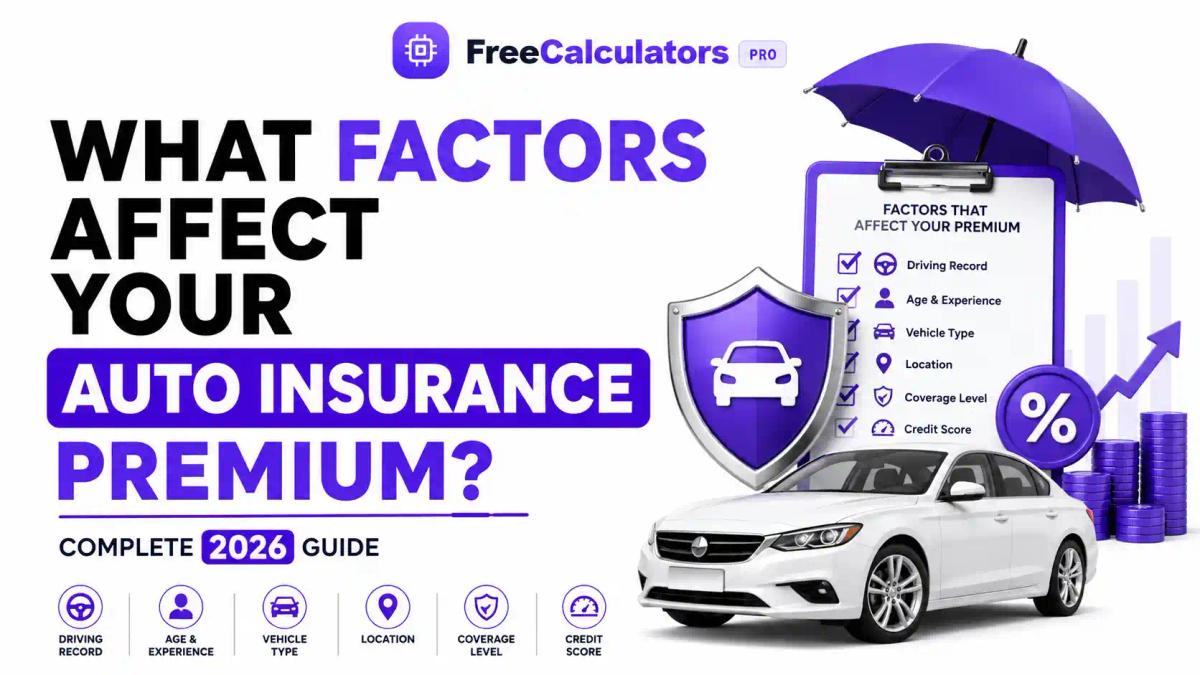
Your auto insurance premium is determined by a mix of personal and vehicle-related risk factors: driving record, age, location, credit-based insurance score, vehicle type, coverage limits, deductible, annual mileage, and claims history. Insurers combine these into a risk profile — the higher your predicted risk of a claim, the higher your premium. Improving any of these factors can lower your rate.
Introduction
If you've ever opened your renewal notice and wondered why your car insurance premium jumped even though you didn't file a claim, you're not alone. Auto insurance pricing can feel like a black box, but it isn't random. Behind every quote is a structured process called underwriting, where insurers weigh dozens of data points to estimate how likely you are to file a claim — and how expensive that claim might be.
Understanding these auto insurance rating factors puts you back in control. Once you know what actually moves the needle on price, you can make targeted changes — adjusting your deductible, improving your driving record, or comparing quotes — instead of guessing. Before diving in, it's worth running your numbers through an auto insurance calculator to see how different variables affect your estimated premium in real time.
This guide breaks down every major factor that affects your auto insurance premium, how insurers use predictive analytics and telematics to price risk, and practical, evidence-based ways to lower your costs in 2026.
What Is an Auto Insurance Premium?
An auto insurance premium is the amount you pay — monthly, semi-annually, or annually — to keep your policy active. It's essentially the price of transferring financial risk from you to the insurance company. If you're in an accident, the insurer covers the agreed costs (up to your policy limits) in exchange for that premium.
Premiums aren't flat fees. They're calculated using actuarial science, a field of applied statistics that estimates the probability and cost of future claims based on historical data. This is why two neighbors with the same car can pay very different rates — their individual risk profiles differ.
How Auto Insurance Companies Calculate Premiums
Insurers rely on underwriting guidelines and statistical modeling to translate your personal data into a price. The process generally works like this:
- Data collection — Your application, motor vehicle report, credit-based insurance score (where legally permitted), and vehicle details are gathered.
- Risk segmentation — You're grouped with drivers who share similar characteristics (age, location, driving history).
- Loss probability modeling — Actuaries estimate claims frequency (how often people in your segment file claims) and claims severity (how expensive those claims tend to be).
- Premium adjustment — Discounts, surcharges, and state regulations are applied to finalize your rate.
Organizations like the Insurance Information Institute (Triple-I) and the National Association of Insurance Commissioners (NAIC) publish guidance and data that help standardize how these models operate across states, though every insurer's proprietary formula differs slightly.
The Core Factors Affecting Your Auto Insurance Premium
1. Driving History and Claims History
Your driving record is the single most influential factor. Accidents, DUI insurance rates, speeding ticket insurance surcharges, and other violations signal higher risk. A clean, claim-free record typically qualifies you for a good driver discount, while multiple violations within a three-to-five-year window can significantly raise your rate.
2. Age and Driving Experience
Younger, less experienced drivers statistically file more claims, which is why insurance for young drivers tends to cost more. Rates generally decline in your mid-20s and stay relatively stable until senior years, when they may rise again slightly due to age-related risk factors.
3. Location and ZIP Code
Where you live and park your car matters. Urban ZIP codes with higher traffic density, theft rates, and accident frequency typically carry higher premiums than rural areas. State insurance laws — including whether you live in a no-fault or at-fault state — also shape baseline pricing. You can compare regional differences using a car insurance calculator that factors in location-based pricing trends.
4. Credit-Based Insurance Score
In most U.S. states, insurers use a credit-based insurance score as part of their risk assessment. Studies cited by the Federal Trade Commission (FTC) have found a correlation between credit history and claims likelihood, though several states restrict or ban this practice entirely — so check your state's specific insurance rules.
5. Vehicle Type, Age, and Safety Features
Repair costs, vehicle depreciation, and theft rates all factor into vehicle insurance rates. Cars with advanced driver assistance systems (ADAS), anti-theft devices, and strong crash-test ratings often qualify for discounts, while high-performance or luxury vehicles typically cost more to insure due to higher replacement cost.
6. Annual Mileage
The more you drive, the more exposure you have to potential accidents. Low-mileage drivers — including remote workers with reduced commutes — often qualify for usage-based or pay-per-mile discounts.
7. Coverage Limits and Deductible Amount
Higher liability coverage and lower deductibles increase your premium because the insurer is taking on more financial responsibility. Raising your deductible amount can meaningfully lower your monthly cost, provided you can comfortably cover that amount out of pocket if you file a claim.
8. Marital Status, Occupation, and Education Level
Statistically, married drivers and those in certain occupations or education brackets file fewer claims, which some insurers factor into pricing where state law allows.
9. Telematics and Usage-Based Insurance
Programs like Progressive Snapshot, State Farm Drive Safe & Save, Allstate Drivewise, Liberty Mutual RightTrack, and Nationwide SmartRide use a telematics device or mobile app to track real driving behavior — braking habits, speed, mileage, and time of day. Safe driving habits captured through these programs can unlock substantial discounts.
10. Policy History and Insurance Continuity
Gaps in coverage or frequent switching between insurers can be viewed as a risk signal, sometimes resulting in higher quoted rates compared to drivers with continuous coverage.
Why Did My Insurance Premium Increase Without a Claim?
This is one of the most common questions drivers ask. Even a claim-free year doesn't guarantee a flat renewal. Common reasons include:
- Rising repair costs and vehicle parts inflation industry-wide
- Increased claims frequency in your ZIP code or state
- Loss of a discount (e.g., aging out of a good student discount)
- Rate filings approved by your state's insurance regulator
- Inflation affecting overall claims severity across the insurer's book of business
Best Free Tools to Estimate and Compare Your Premium
Before you commit to a policy, it helps to model different scenarios. FreeCalculators.tools offers several free resources designed to help you plan smarter:
- Auto Insurance Calculator — estimate your premium based on coverage and risk inputs
- Car Insurance Calculator — compare cost scenarios by deductible and coverage level
- Life Insurance Calculator — for households reviewing overall financial protection
- Term Life Insurance Calculator — useful when bundling financial planning decisions
- Homeowners Insurance Calculator — helpful if you're bundling home and auto policies
- Whole Life Insurance Calculator — for long-term financial planning alongside insurance costs
These tools won't replace an official quote, but they give you a realistic starting point before you talk to an agent or compare insurers.
Common Mistakes That Increase Your Premium
- Underestimating annual mileage on your application, which can lead to rate corrections later.
- Letting coverage lapse even for a short period between policies.
- Choosing the lowest deductible by default without comparing the long-term cost difference.
- Not shopping around at renewal — loyalty rarely earns you the best rate.
- Ignoring available discounts like multi-policy, good student, or telematics programs.
- Failing to update your policy after major life changes (marriage, moving, new vehicle).
- Assuming minimum coverage is always cheaper long-term — a serious at-fault accident with minimum liability coverage can leave you financially exposed.
Practical Examples
Example 1 — Young Driver: A 19-year-old with a new license, financed vehicle, and urban ZIP code will likely see a much higher premium than a 45-year-old with 20 years of clean driving history — even with identical coverage limits.
Example 2 — Deductible Trade-Off: Raising a comprehensive deductible from $500 to $1,000 might lower a driver's premium by 10–15%, but they'd need to be prepared to pay that higher amount out of pocket after a covered claim.
Example 3 — Telematics Savings: A low-mileage, cautious driver enrolled in a usage-based insurance program may see a meaningful discount within the first renewal cycle after demonstrating safe driving habits.
Future Trends in Auto Insurance Pricing
- AI-powered underwriting is expanding, allowing insurers to process broader data sets faster and more accurately.
- Real-time telematics pricing is moving beyond annual discounts toward continuously adjusted rates.
- Connected and autonomous vehicle insurance models are emerging as ADAS and self-driving technology mature.
- Embedded insurance at vehicle purchase is becoming more common, integrating coverage directly into the car-buying process.
- Climate-related regional risk is increasingly factored into premium models as extreme weather events affect claims frequency in certain states.
- Personalized risk scoring using machine learning is expected to make pricing more individualized — and potentially more transparent — over time.
Frequently Asked Questions
What factors affect your auto insurance premium the most? Driving history, age, location, vehicle type, and coverage limits generally carry the most weight. Claims history and credit-based insurance score (where permitted) also play a significant role in how insurers calculate your final rate.
Does credit score affect car insurance? In most states, yes. Insurers use a credit-based insurance score, which research has linked to claims likelihood. Some states, including California and Massachusetts, restrict or prohibit this practice entirely.
Can I lower my auto insurance premium? Yes. Raising your deductible, bundling policies, enrolling in a telematics or usage-based program, maintaining a clean driving record, and comparing quotes annually are proven ways to reduce your premium over time.
Does my ZIP code affect insurance rates? Yes. ZIP code reflects local accident frequency, theft rates, and repair costs, all of which insurers factor into regional pricing models.
How does mileage impact my premium? Higher annual mileage increases your exposure to potential accidents, which typically raises your premium. Low-mileage or remote-work drivers often qualify for discounted, usage-based rates.
Is raising my deductible worth it? It depends on your financial cushion. A higher deductible lowers your premium but increases your out-of-pocket cost if you file a claim, so it's worth modeling both scenarios with a calculator before deciding.
How often do insurance premiums change? Most insurers reassess premiums at each policy renewal (typically every six or twelve months), factoring in updated driving records, claims, and broader rate filings approved by state regulators.
How can young drivers lower insurance costs? Good student discounts, driver's education completion, staying on a parent's policy, choosing a safer vehicle, and enrolling in telematics programs are among the most effective ways young drivers reduce premiums.
Does the type of car I drive affect my premium? Yes. Vehicle value, repair costs, safety ratings, and theft rates all influence pricing. Vehicles with strong ADAS features and anti-theft devices often qualify for lower rates.
Key Takeaways
- Auto insurance premiums are calculated using actuarial models that weigh driving history, age, location, vehicle type, and coverage choices.
- Credit-based insurance scores affect pricing in most states, though rules vary.
- Telematics and usage-based insurance programs reward measurably safe driving habits with real discounts.
- Raising your deductible can lower your premium, but requires financial preparedness for claims.
- ZIP code and state insurance laws significantly influence baseline rates.
- Premiums can rise even without a claim due to inflation, rate filings, or lost discounts.
- Comparing quotes annually and using free estimation tools helps you catch better rates before renewal.
Expert Summary
Auto insurance premiums reflect a data-driven risk assessment rather than a fixed price. Insurers combine driving history, claims history, credit-based insurance score, vehicle characteristics, location, and coverage choices into a predictive model that estimates your likelihood and cost of future claims. Telematics and usage-based programs are increasingly shifting pricing toward real driving behavior rather than static demographics. Drivers who understand these rating factors — and actively manage the ones within their control, like deductible level, coverage limits, and driving habits — are best positioned to secure fair, competitive premiums over time.
Conclusion
Your auto insurance premium isn't arbitrary — it's the output of a detailed risk model built on your driving record, location, vehicle, coverage choices, and more. While some factors, like your age or ZIP code, are outside your control, many others — your deductible, your driving habits, your coverage limits, and how often you compare quotes — are entirely within reach. Small, informed adjustments can add up to meaningful savings over the life of your policy.
Call To Action
Ready to see how these factors apply to your own situation? Visit FreeCalculators.tools to explore free, easy-to-use financial calculators — including tools for auto insurance, life insurance, and home insurance planning — and make more confident, informed decisions about your coverage. You can also browse our full blog library for more insurance and personal finance guides, learn more about us, explore our services, or contact us with questions.