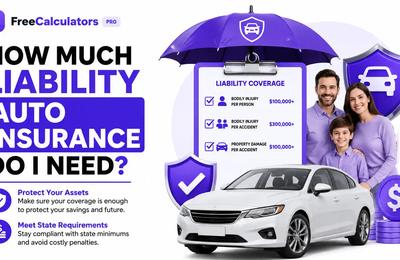
Liability insurance pays for damage or injuries you cause to other people in an accident, and it's legally required in nearly every state. Comprehensive insurance is optional coverage that pays to repair or replace your own vehicle after non-collision events like theft, fire, vandalism, hail, or hitting an animal. Most drivers with a car loan carry both.
If you've ever stared at an auto insurance quote wondering why there are five different types of coverage listed, you're not alone. Two of the most commonly confused terms are liability insurance and comprehensive insurance. They sound similar, they often appear on the same policy, and yet they protect against completely different risks.
Understanding the difference isn't just a matter of insurance trivia — it directly affects your wallet, your legal compliance, and how protected you actually are the next time something happens to your car. In this guide, we'll break down exactly what each coverage does, when you legally need it, when it's smart to add it voluntarily, and how to decide what's right for your situation. Along the way, you can use a free auto insurance calculator to estimate your own costs as we go.
What Is Liability Insurance?
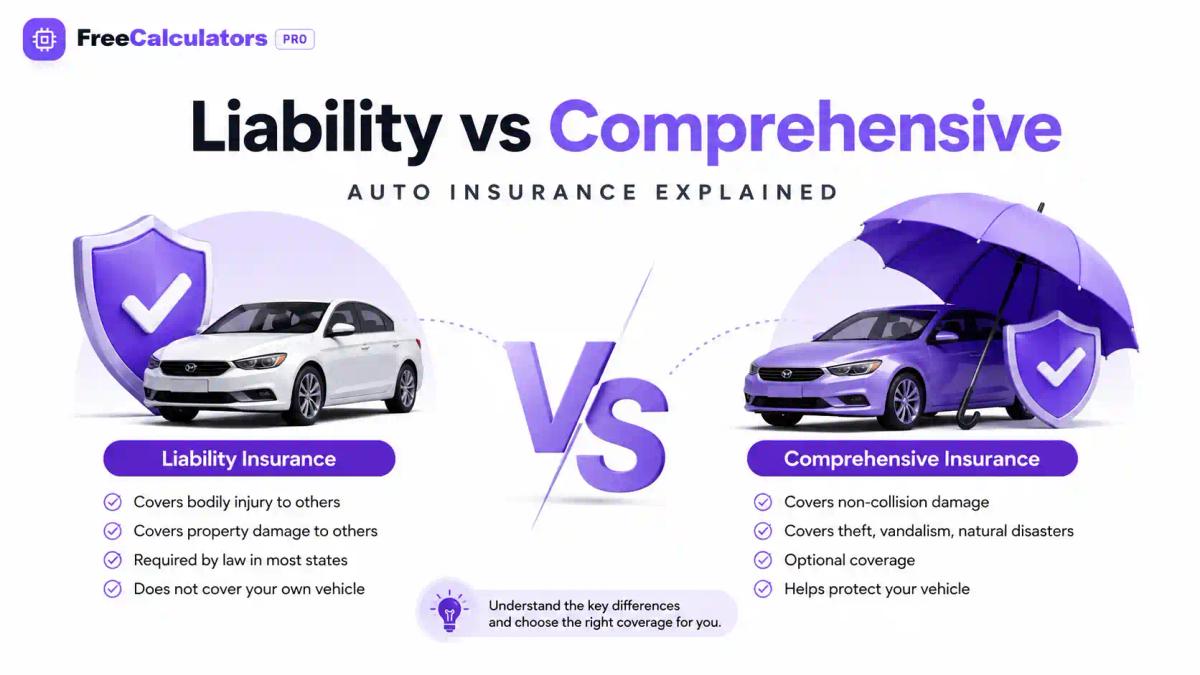
Liability insurance is the coverage that pays for damage or injuries you cause to someone else — their car, their property, or their body — when you're at fault in an accident. It does not pay to fix your own vehicle.
Liability insurance is typically split into two parts:
- Bodily injury liability – covers medical expenses, lost wages, and legal costs if you injure someone else
- Property damage liability – covers repair costs if you damage another person's car, fence, mailbox, or other property
Every U.S. state except New Hampshire and Virginia (which have alternative financial responsibility rules) requires drivers to carry a minimum amount of liability coverage. State minimums are usually written as three numbers, such as 25/50/25, representing thousands of dollars in bodily injury per person, bodily injury per accident, and property damage.
Because it's mandated by state insurance laws, liability coverage is the foundation every auto policy is built on. If you're comparing quotes from providers like GEICO, State Farm, Progressive, or Allstate, liability limits are usually the first numbers you'll see.
You can check current requirements for your state through resources like the National Association of Insurance Commissioners (NAIC), which publishes state-by-state minimum coverage guidelines.
What Is Comprehensive Insurance?
Comprehensive insurance, sometimes called "other than collision" coverage, pays to repair or replace your vehicle when it's damaged by something other than a crash with another car. This includes:
- Theft
- Vandalism
- Fire
- Hail, flooding, or storm damage
- Falling objects (branches, debris)
- Hitting an animal (like a deer)
- Windshield and glass damage
Unlike liability, comprehensive insurance is optional under state law — but if you're financing or leasing your vehicle, your lender will almost always require it as a condition of the loan. Comprehensive coverage comes with a deductible, meaning you pay a set amount out of pocket before the insurer covers the rest.
If you want to see how a deductible changes your premium, freecalculators.tools' car insurance calculator can help you model different scenarios before you commit to a policy.
Liability vs. Comprehensive: Key Differences
| Feature | Liability Insurance | Comprehensive Insurance |
| What it covers | Damage/injury to others | Damage to your own car |
| Legally required | Yes, in most states | No (unless required by lender) |
| Covers collisions with other cars | Yes | No (that's collision coverage) |
| Covers theft/vandalism/weather | No | Yes |
| Has a deductible | No | Yes |
| Required for financed/leased cars | Yes | Usually yes |
This table alone answers the most common search: liability vs. comprehensive comparison. But the real-world decision goes deeper than a checklist — it depends on your vehicle's value, your budget, and your risk tolerance.
Does Liability Insurance Cover My Own Car?
No. This is one of the most frequent misconceptions drivers have. Liability insurance never pays to repair your own vehicle, regardless of who caused the accident. If you only carry liability and you're at fault in a crash, you'll pay out of pocket for your own car's repairs. If you want your own vehicle protected in an at-fault collision, you need collision coverage — a separate add-on from comprehensive.
Does Comprehensive Insurance Cover Theft and Vandalism?
Yes. Theft and vandalism are two of the most common comprehensive claims. If your car is stolen and never recovered, comprehensive coverage will typically pay out based on the vehicle's actual cash value (ACV) at the time of the loss — not what you originally paid for it. This is an important distinction, since depreciation can significantly lower a payout on an older vehicle.
Comprehensive vs. Collision: Don't Confuse These Two
Because "comprehensive" and "collision" are often bundled together as full coverage, people frequently mix them up:
- Comprehensive = non-collision events (theft, weather, animals, vandalism)
- Collision = impact with another vehicle or object, regardless of fault
You can carry comprehensive without collision, or vice versa, but most lenders require both if you're financing a vehicle. Together with liability, these three coverages make up what's commonly marketed as "full coverage" auto insurance.
Who Needs Comprehensive Insurance?
Comprehensive coverage makes the most sense for:
- Financed or leased vehicles – lenders typically require it
- Newer or higher-value cars – more expensive to replace out of pocket
- Drivers in high-risk areas – regions prone to hail, flooding, wildfire, or high theft rates
- Anyone without emergency savings – a stolen or storm-damaged car can be a major financial hit without coverage
On the other hand, if you own an older, low-value vehicle outright and have enough savings to replace it if needed, dropping comprehensive coverage may make financial sense. A good rule of thumb: if your annual comprehensive premium plus deductible is close to or more than 10% of your car's actual cash value, it may be time to reconsider.
To run these numbers yourself, freecalculators.tools' term life insurance calculator and other planning tools can help you view auto insurance costs in the context of your broader financial picture, alongside home and life coverage decisions.
How Auto Insurance Premiums Are Calculated
Both liability and comprehensive premiums are priced using a mix of factors insurers evaluate during underwriting, including:
- Driving history and claims record
- Vehicle make, model, and age
- Location and local theft/weather risk
- Credit-based insurance score (in most states)
- Annual mileage
- Deductible amount chosen
- Coverage limits selected
Insurers increasingly use telematics and usage-based insurance (UBI) programs, which track real driving behavior through a mobile app or plug-in device, to offer personalized discounts. This is a growing trend worth watching if you're comparing quotes across multiple companies.
Best Free Tools to Estimate Your Coverage Costs
Before you commit to a policy, it helps to model your numbers rather than guess. FreeCalculators.tools offers several free planning tools that pair well with insurance decisions:
- Auto Insurance Calculator – estimate premiums based on coverage levels and deductibles
- Car Insurance Calculator – compare liability-only vs. full coverage costs
- Life Insurance Calculator – see how auto insurance fits into your broader risk protection plan
- Homeowners Insurance Calculator – useful if you're bundling auto and home policies
- Whole Life Insurance Calculator – for households evaluating long-term financial protection
- 529 Calculator and College Savings Calculator – helpful if you're balancing insurance costs against other savings goals
These tools won't replace an actual quote from an insurer, but they give you a realistic starting point before you talk to an agent or shop online.
Common Mistakes Drivers Make
- Assuming liability covers their own car – it doesn't, ever, regardless of fault.
- Dropping comprehensive too early on a financed car – this can violate your loan agreement.
- Choosing the state minimum liability limit without considering real risk – a serious accident can easily exceed low limits, leaving you personally liable for the difference.
- Not comparing deductible options – a higher comprehensive deductible lowers your premium but increases out-of-pocket cost at claim time.
- Forgetting to reassess coverage as the car ages – what made sense on a brand-new car may not make sense five years later.
- Ignoring bundling discounts – combining auto with home or renters insurance can lower overall premiums.
Practical Examples
Example 1 — At-fault accident: You rear-end another driver. Your liability coverage pays for their car repairs and medical bills. It does not pay for your own car's damage — that would require collision coverage.
Example 2 — Hailstorm: A hailstorm dents your hood and cracks your windshield while parked. Comprehensive coverage pays for these repairs, minus your deductible, since no other vehicle was involved.
Example 3 — Stolen vehicle: Your car is stolen from a parking lot and never recovered. Comprehensive coverage pays out based on the vehicle's actual cash value at the time of the theft.
Example 4 — Deer collision: You hit a deer on a rural road. Because there's no other car involved, this is classified as a comprehensive claim, not a collision claim.
Future Trends in Auto Insurance Coverage
- AI-powered underwriting is making pricing more personalized and precise, using driving data rather than broad demographic assumptions.
- Telematics and usage-based insurance are expanding, rewarding low-mileage and safe drivers with lower premiums.
- EV-specific comprehensive coverage is emerging as electric vehicles bring different repair costs and risk profiles, particularly around battery replacement.
- Climate-driven comprehensive claims are rising as extreme weather events become more frequent, pushing insurers to reassess comprehensive pricing in high-risk regions.
- Digital claims processing is speeding up settlement times, with many insurers now offering app-based photo claims for comprehensive damage.
Frequently Asked Questions
What is liability insurance? Liability insurance is coverage that pays for injuries or property damage you cause to other people in an at-fault accident. It's required in nearly every U.S. state and does not cover damage to your own vehicle.
What is comprehensive insurance? Comprehensive insurance pays to repair or replace your own car after non-collision events like theft, vandalism, fire, hail, flooding, or hitting an animal. It's optional unless required by a lender.
Is comprehensive insurance required by law? No. Comprehensive insurance isn't mandated by state law, but lenders financing or leasing a vehicle almost always require it as a loan condition.
Does liability insurance cover my own car in an accident? No. Liability only pays for damage or injuries to other people involved in an accident you caused. Your own vehicle's repairs require collision or comprehensive coverage instead.
Does comprehensive insurance cover theft? Yes. Theft is one of the most common comprehensive claims, and payouts are based on the vehicle's actual cash value at the time of loss.
What's the difference between comprehensive and collision insurance? Comprehensive covers non-collision events like weather, theft, and vandalism. Collision covers damage from hitting another vehicle or object, regardless of fault.
Should I drop comprehensive insurance on an older car? It depends on the car's value. If your annual premium and deductible together approach 10% of the vehicle's actual cash value, dropping comprehensive may save more money than it protects.
Is comprehensive insurance worth it for a financed car? Yes, and typically required. Lenders want their financial interest protected in case the car is stolen, totaled, or damaged by a non-collision event.
How is my auto insurance premium calculated? Insurers weigh your driving record, vehicle type, location, credit-based insurance score, mileage, and chosen deductible and limits to calculate liability and comprehensive premiums.
Can I have comprehensive insurance without collision coverage? Yes, they're separate coverages you can purchase independently, though many drivers who want strong protection choose both together.
Key Takeaways
- Liability insurance covers damage or injuries you cause to others; it's legally required in most states.
- Comprehensive insurance covers your own vehicle for non-collision events like theft, fire, weather, and animal collisions.
- Comprehensive is optional under state law but usually required by lenders on financed or leased vehicles.
- Comprehensive claims are subject to a deductible and are paid out based on actual cash value.
- Liability never pays for your own car's repairs, regardless of fault.
- Comprehensive and collision are different coverages, often bundled together as "full coverage."
- Your vehicle's age and value should guide whether comprehensive coverage still makes financial sense.
- Free tools can help you estimate premiums before committing to a policy.
Expert Summary
Liability and comprehensive auto insurance serve fundamentally different purposes: one protects others from damage you cause, the other protects your own vehicle from non-collision risks like theft, weather, and vandalism. Liability is mandatory in nearly all states; comprehensive is optional but commonly required by lenders. Choosing the right combination depends on your vehicle's value, your financial cushion, and your state's minimum requirements. Reviewing your coverage annually — and running the numbers with a calculator before renewing — helps ensure you're neither underinsured nor overpaying for protection you no longer need.
Conclusion
Liability and comprehensive insurance aren't competing options — they're complementary pieces of a well-rounded auto insurance policy, each protecting against a different kind of risk. Liability keeps you legally compliant and protects others; comprehensive protects your own investment in your vehicle. The right balance comes down to what you drive, how you drive, and what you can afford to lose.
Ready to Compare Your Coverage Costs?
Before you renew or switch your policy, take a few minutes to run your numbers. Visit FreeCalculators.tools for free, easy-to-use calculators covering auto insurance, life insurance, homeowners insurance, and more — all designed to help you make confident, informed financial decisions. Explore our full library of tools and calculators, check out our blog for more insurance and personal finance guides, or contact us if you have questions about which planning tool is right for you.