Insurance companies don't choose your premium randomly. Every dollar is based on specific risk factors—and once you know how they're calculated, you'll never look at an insurance quote the same way again.
To estimate car insurance costs manually, add up your state's minimum liability requirements, then layer on collision and comprehensive costs based on your vehicle's value, subtract savings from your deductible choice, and adjust for your driving record, age, ZIP code, and credit-based insurance score. Most drivers can get a reasonably close ballpark figure using state average premiums as a starting baseline.
Introduction
Getting an accurate sense of what you'll pay for auto insurance before you ever request a quote can save you time, stress, and sometimes money. Whether you're shopping for a new car, comparing coverage options, or just trying to understand why your bill looks the way it does, learning how to estimate car insurance costs manually puts you in control of the conversation instead of just reacting to whatever number an insurer hands you.
This guide walks through the real factors that go into insurance premium calculation, breaks down the math insurers actually use, and gives you a step-by-step framework you can apply with nothing more than a pen, paper, or a simple spreadsheet — no online quote required. Along the way, we'll also point you toward useful tools, like the car insurance calculator on FreeCalculators.tools, that can speed up the process once you understand the underlying logic.
What Is a Manual Car Insurance Estimate?
A manual car insurance estimate is a self-calculated approximation of your annual or monthly insurance premium, built without submitting personal information to an insurer or running an online quote tool. Instead, you use publicly available data — state average premiums, coverage type costs, and rating factor adjustments — to build your own number from the ground up.
This differs from an automated insurance premium estimator, which pulls from a live database and a proprietary insurance rating algorithm. A manual estimate won't be perfectly precise, but it gives you a defensible range you can use for budgeting, vehicle shopping, or double-checking a quote that seems unusually high.
If you want a faster starting point before diving into manual math, the auto insurance calculator can help you sanity-check your numbers as you go.
Why Manual Estimation Matters
Understanding how insurance companies price auto insurance isn't just an academic exercise. It's practical:
- You can budget for a new car purchase before you finance it.
- You can catch pricing errors or unjustified premium hikes.
- You can evaluate whether liability-only or full coverage makes more financial sense for your situation.
- You can negotiate more confidently with an agent or compare online quotes against a baseline you trust.
According to the Insurance Information Institute (Triple-I), auto insurance pricing is heavily influenced by regional claim frequency, vehicle repair costs, and state regulatory frameworks — all factors a manual estimate can account for.
How Insurance Companies Calculate Premiums
Underwriting and actuarial pricing are the two pillars behind every premium. Insurers use historical claims data to predict the probability that a given driver will file a claim, then price the policy so that, across thousands of similar policyholders, the company collects enough in premiums to cover expected claim probability, administrative costs, and profit margin.
The basic insurance pricing formula looks something like this:
Base Rate × Rating Factors × Coverage Selections − Discounts = Your Premium
Each rating factor nudges the base rate up or down. Let's break down what actually goes into that formula.
1. Base Rate by State and Vehicle Type
Every insurer sets a base rate for a given ZIP code and vehicle class before any personal adjustments are applied. This reflects local accident frequency, repair costs, weather risk, and even local litigation trends. You can find average premiums by state through resources like the NAIC and Triple-I, both of which publish annual countrywide averages.
2. Coverage Type Costs
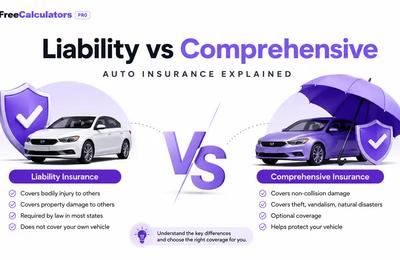
- Liability coverage (bodily injury liability + property damage liability): usually the cheapest, and legally required in nearly every state.
- Collision coverage: pays for damage to your own car after an at-fault accident; priced based on your vehicle value and repair cost history.
- Comprehensive coverage: covers theft, weather, and non-collision events; typically the smallest cost component.
- Uninsured motorist coverage and personal injury protection (PIP): required or optional depending on your state.
If you're weighing whether to carry liability-only or bundle everything into full coverage insurance, the homeowners insurance calculator and its auto counterpart can help you compare the trade-offs side by side.
3. Deductible Amount
Your deductible amount is inversely related to your premium. Choosing a $1,000 deductible instead of a $500 deductible on collision and comprehensive typically lowers your premium by roughly 10–20%, though the exact percentage varies by insurer.
4. Driving Record and Claim History
A clean driving history is one of the single biggest premium reducers. One at-fault accident can raise premiums 20–50%, while a DUI or reckless driving conviction can nearly double your rate for several years.
5. Age, Gender, and Marital Status
Younger, less experienced drivers pay significantly more due to statistically higher accident frequency. Rates generally decline steadily from the late teens through the mid-20s and stabilize by the early 30s.
6. ZIP Code and Rating Territory
Rating territory matters because insurers track claims data down to the ZIP code level. Urban areas with higher theft and accident rates typically carry higher base rates than rural ones.
7. Credit-Based Insurance Score
In most states (though not all — some ban this practice), a credit-based insurance score factors into pricing. Research cited by the Consumer Financial Protection Bureau (CFPB) has shown a statistical correlation between credit history and claims frequency, which is why many insurers use it as a rating variable.
8. Annual Mileage
Fewer miles driven per year generally means a lower annual mileage rating factor, since exposure to accidents decreases with less time on the road.
Step-by-Step: How to Estimate Car Insurance Costs Manually
Here's a practical framework you can follow with a notebook or a simple spreadsheet.
Step 1: Find your state's average annual premium. Start with published averages from the NAIC or Triple-I as your baseline anchor.
Step 2: Adjust for coverage type. If you only need liability coverage, subtract roughly 35–45% from the full-coverage average. If you want full coverage, use the state average as-is.
Step 3: Adjust for deductible. Raising your deductible from $500 to $1,000 typically reduces your premium estimate by 10–20%.
Step 4: Adjust for driving record. Add 20–50% for one at-fault accident in the last three years. Add more for multiple violations or a DUI.
Step 5: Adjust for age. Drivers under 25 should multiply their running estimate by roughly 1.5–2x. Drivers 30–60 with clean records can generally use the base estimate as-is.
Step 6: Adjust for vehicle type. Sports cars, luxury vehicles, and electric vehicles with expensive parts tend to run 15–30% above average due to higher repair and replacement value costs.
Step 7: Apply likely discounts. Subtract for safe driver discounts, multi-policy bundling, anti-theft devices, and low mileage — often a combined 10–25% reduction.
Step 8: Total it up. What remains is your manual estimate — not a guaranteed quote, but a realistic range to work from.
For a faster version of this same math, the car insurance calculator automates these adjustments while still letting you see how each factor changes your number.
Manual Estimate vs. Online Quote Calculator
| Factor | Manual Estimate | Online Quote Calculator |
| Accuracy | Provides an approximate cost range | Offers a more accurate, personalized estimate |
| Personal Information Required | No personal information needed | Requires details such as name, ZIP code, vehicle information (VIN), driver's license, etc. |
| Speed | Slower but helps you understand how premiums are calculated | Instant results within seconds |
| Best For | Budget planning and comparing costs before buying a vehicle | Getting a final insurance quote before purchasing a policy |
| Privacy | High – no personal data is shared | Lower – personal information is typically required to generate a quote |
A manual estimate is best used before you're ready to share personal information — for example, when you're still deciding whether to buy a car at all. Once you're ready to buy or switch policies, an actual quote will always be more precise.
Best Free Tools for Estimating Insurance and Related Costs
While manual estimation builds understanding, free calculators can speed up the process and cross-check your math. FreeCalculators.tools offers a growing library of planning tools, including:
- Car Insurance Calculator
- Auto Insurance Calculator
- Life Insurance Calculator
- Term Life Insurance Calculator
- Whole Life Insurance Calculator
- Homeowners Insurance Calculator
- FIRE Calculator for broader financial planning
- 529 Calculator if you're also planning for education costs alongside insurance and vehicle expenses
These tools won't replace an official quote, but they're useful for narrowing your expectations before you talk to an agent or fill out a formal application.
Common Mistakes When Estimating Car Insurance Manually
- Ignoring state minimums. Every state sets different minimum liability requirements, and using a national average without adjusting for your state skews the estimate.
- Forgetting about credit-based insurance score impact. Drivers with lower credit scores often underestimate their real premium.
- Overlooking vehicle-specific risk. Two cars in the same price range can have very different insurance costs due to repair costs, theft rates, or safety ratings.
- Not accounting for claim history correctly. A single accident can affect pricing for three to five years, not just the current renewal.
- Assuming discounts automatically apply. Discounts like safe-driver or multi-policy bundling must usually be requested or verified — they're not always baked into a manual estimate unless you subtract them yourself.
- Confusing liability-only with full coverage numbers. Comparing a liability-only manual estimate against a full-coverage online quote leads to confusion about why the numbers don't match.
Practical Examples
Example 1: New driver, used sedan, average state
- State average (full coverage): ~$2,150/year
- Age adjustment (under 25): +60%
- Clean driving record: no adjustment
- $500 deductible: no adjustment
- Estimated range: $3,200–$3,600/year
Example 2: Experienced driver, financed SUV, high-cost state
- State average (full coverage): ~$2,800/year
- Age 35–45, clean record: no adjustment
- $1,000 deductible: −15%
- Multi-policy discount: −10%
- Estimated range: $2,100–$2,400/year
Example 3: Liability-only, older paid-off car, low-cost state
- State average (full coverage): ~$1,400/year
- Liability-only adjustment: −40%
- Safe driver discount: −10%
- Estimated range: $750–$850/year
These examples show how the same base framework produces very different numbers depending on the inputs — which is exactly why a manual estimate should be treated as a range, not a fixed figure.
Future Trends in Car Insurance Pricing
- Usage-Based Insurance (UBI) and telematics are shifting pricing from static rating factors toward real-time driving behavior.
- Connected vehicle data is increasingly feeding into underwriting models, potentially replacing some traditional rating variables.
- AI-assisted premium forecasting is helping insurers — and eventually consumers — model costs more dynamically.
- EV-specific pricing models are evolving as insurers gather more repair-cost data on electric vehicles.
- Climate risk modeling is becoming a larger factor in regional base rates, particularly in states prone to severe weather.
Frequently Asked Questions
What is a manual car insurance estimate? A manual car insurance estimate is a self-calculated approximation of your premium based on state averages, coverage type, deductible, and personal rating factors — done without submitting information to an insurer for an official quote.
Can I estimate insurance without getting quotes? Yes. Using published state average premiums combined with adjustments for your driving record, vehicle type, deductible, and coverage level, you can build a reasonably accurate range without contacting an insurer directly.
How accurate are manual insurance estimates? Manual estimates are typically within 15–30% of an actual quote, since they rely on averages rather than an insurer's proprietary underwriting model. They're best used for budgeting rather than final purchase decisions.
Which factor affects insurance costs the most? Driving record and claim history typically have the largest single impact, followed by age, location, and vehicle type. A single at-fault accident can raise premiums by 20–50%.
Does credit score affect car insurance rates? In most states, yes. Insurers use a credit-based insurance score as one rating factor because data shows a correlation between credit history and claims frequency, though several states have restricted or banned this practice.
How does deductible affect my premium? A higher deductible lowers your premium because you're absorbing more of the financial risk yourself. Moving from a $500 to a $1,000 deductible commonly reduces premiums by 10–20%.
Should I estimate insurance before buying a car? Yes. Vehicle type significantly affects premiums due to repair costs, theft rates, and safety ratings, so estimating insurance before you finance or purchase a car helps avoid budget surprises.
Is a manual estimate useful before financing a vehicle? Absolutely. Lenders often require proof of insurance, and knowing your likely premium range in advance helps you budget your total monthly vehicle cost accurately.
Why do ZIP codes change insurance prices? Insurers rate by territory because local accident frequency, theft rates, and repair costs vary significantly by area, even within the same state.
Can spreadsheets estimate premiums accurately? A spreadsheet can organize and apply the same adjustment logic used in manual estimation — state averages, coverage adjustments, and discounts — making it a helpful way to test multiple scenarios quickly.
Key Takeaways
- A manual car insurance estimate starts with your state's average premium and layers on adjustments for coverage type, deductible, driving record, age, and location.
- Underwriting and actuarial pricing models predict claim probability to set your base rate.
- Deductible choice, driving history, and credit-based insurance score are among the most influential rating factors.
- Manual estimates are best for budgeting and pre-purchase planning, not as a replacement for an official quote.
- Free tools like the car insurance calculator can speed up the process once you understand the underlying formula.
- Comparing liability-only versus full coverage estimates separately avoids confusion when checking your math against real quotes.
- Emerging trends like telematics and usage-based insurance are gradually shifting pricing away from static rating factors.
Expert Summary
Estimating car insurance manually means combining your state's average premium with adjustments for coverage type, deductible, driving record, vehicle type, and personal rating factors like age and credit-based insurance score. While not a substitute for an official quote, this approach — grounded in the same underwriting logic insurers use — gives consumers a transparent, privacy-friendly way to budget for a vehicle purchase, evaluate coverage trade-offs, and sanity-check quotes they receive from providers like GEICO, Progressive, State Farm, or Allstate.
Conclusion
Learning how to estimate car insurance costs manually demystifies one of the more opaque parts of vehicle ownership. Once you understand the rating factors insurers actually use — coverage type, deductible, driving record, location, and vehicle risk — you can build a confident estimate before you ever request a formal quote. It won't be perfect, but it will be close enough to guide real financial decisions.
Call to Action
Ready to put these numbers to work? Explore FreeCalculators.tools for free online financial calculators covering insurance, retirement, education savings, and more. Start with the car insurance calculator to turn this manual framework into an instant estimate, or browse the full tools library for additional planning resources tailored to your financial goals.