A car insurance calculator is a free online tool that estimates your auto insurance premium using details like your vehicle, ZIP code, driving history, and coverage preferences. It won't replace a formal quote, but it gives you a realistic cost range in minutes, helping you budget before you shop with a real insurer.
Introduction
If you've ever typed "how much will my car insurance cost" into a search bar at midnight, you're not alone. Car insurance pricing can feel like a black box — two neighbors with nearly identical cars can pay wildly different premiums, and nobody explains why. That's exactly the gap a good car insurance calculator online is meant to fill.
Instead of waiting on hold with an agent or filling out five separate quote forms just to compare numbers, you can plug your details into a calculator and see an estimated insurance cost in a few minutes. Tools like the car insurance calculator on FreeCalculators.tools are built for exactly this — a quick, no-pressure way to understand what you might pay before you ever talk to a sales rep.
This guide walks through how these calculators actually work, what factors move your premium up or down, how U.S. and U.K. pricing differ, and how to use an estimate to actually save money. We'll also point you toward related tools, like an auto insurance calculator and a homeowners insurance calculator, if you're planning your finances more broadly.
What Is a Car Insurance Calculator?
A car insurance calculator is a digital tool that estimates your likely auto insurance premium based on a set of standard rating factors: your vehicle's make and model, your ZIP code or postcode, your age, your driving record, and the type of coverage you want (liability, collision, or comprehensive). Rather than pulling a real-time quote from an insurance carrier's underwriting system, it uses aggregated pricing data and statistical models to approximate what a similar driver, in a similar location, with a similar vehicle would typically pay.
Think of it as a financial planning tool first and a shopping tool second. It won't lock in a rate, but it will give you a grounded number to work with — which is often the missing piece when people are budgeting for a new car, comparing insurance costs before buying, or trying to figure out why their current premium feels high.
How Does a Car Insurance Calculator Work?
Most calculators follow a similar logic to how real insurance underwriting works, just simplified. Here's the general process:
- You enter your details — vehicle year/make/model, ZIP code, age, gender (in states where permitted), marital status, and driving history.
- The tool applies rating factors — each input is weighted based on actuarial data. A 22-year-old with a sports car and one at-fault accident will generate a different risk profile than a 45-year-old with a sedan and a clean record.
- Coverage selections are factored in — choosing full coverage (comprehensive + collision) versus liability-only changes the estimate significantly.
- A cost range is generated — usually a monthly and annual figure, sometimes broken down by coverage type.
Behind the scenes, this mirrors actuarial pricing — the same discipline real insurers use to translate risk into dollars. The difference is that a calculator gives you a directional estimate instantly, without a hard credit pull or a phone call.
Why Do Car Insurance Quotes Vary So Much?
This is one of the most common questions people ask, and it has a straightforward answer: insurers don't all weigh the same factors the same way. One carrier might heavily penalize a recent claims history, while another puts more weight on annual mileage or credit score (where legally allowed). Add in regional differences — repair costs, accident rates, weather, and even litigation patterns vary by state or region — and you get a wide spread of quotes for the exact same driver.
This is exactly why comparison shopping matters, and why starting with a calculator estimate before requesting individual quotes from GEICO, Progressive, State Farm, Allstate, Liberty Mutual, or USAA can save you time. You walk into those conversations already knowing roughly what to expect.
Key Factors That Affect Your Car Insurance Premium
Vehicle-Related Factors
- Make, model, and year (repair cost and theft rate matter)
- Safety ratings and ADAS (advanced driver assistance systems)
- Engine size and whether it's an EV, hybrid, or gas vehicle
Driver-Related Factors
- Age and years of driving experience
- Driving record (accidents, violations, DUIs)
- Claims history over the past 3–5 years
- Annual mileage — low-mileage drivers often qualify for discounts
Location-Related Factors
- ZIP code or postcode (accident frequency, theft rates, local repair costs)
- State-specific minimum coverage laws
- Urban vs. rural driving environment
Coverage-Related Factors
- Liability coverage limits
- Comprehensive coverage and collision coverage add-ons
- Deductible amount chosen
- Uninsured motorist coverage and personal injury protection
Financial and Behavioral Factors
- Credit-based insurance score (where permitted)
- Telematics / usage-based programs that track real driving behavior
- Multi-policy or safe driver discounts
Average Cost of Car Insurance in the USA
According to data regularly cited by the Insurance Information Institute (III) and the National Association of Insurance Commissioners (NAIC), average full coverage premiums in the U.S. typically run several thousand dollars per year, though the exact figure shifts annually and varies enormously by state. States with high litigation rates or dense urban traffic (like Florida, Louisiana, or Michigan) tend to sit well above the national average, while states with lower population density often land below it.
If you want a number specific to your situation rather than a national average, running your details through a car insurance calculator will get you closer to reality than any generic statistic.
Car Insurance Calculators in the UK
For readers in the United Kingdom, the mechanics are similar but the terminology differs slightly. Instead of "liability" and "full coverage," UK drivers typically choose between third-party, third-party fire and theft, and comprehensive car insurance. A motor insurance premium in the UK is also influenced by your postcode, no-claims discount history, annual mileage, and the car's insurance group rating.
UK insurance premium calculator tools generally ask for similar inputs — vehicle details, postcode, driving history, and coverage type — and produce a comparable monthly or annual estimate. Whether you're in Manchester or Miami, the underlying goal of the calculator is the same: give you a realistic number before you commit.
How to Use an Online Insurance Estimator Step by Step
- Gather your vehicle details — VIN, make, model, and year.
- Know your ZIP code or postcode, since location is one of the biggest pricing levers.
- Decide roughly what coverage you want (state/legal minimum vs. full coverage).
- Enter your driving history honestly, including any accidents or violations.
- Review the estimate range, not just a single number.
- Use that estimate to compare against real quotes from at least three carriers.
This is also a smart step to take before buying a car — estimating insurance for a used or new vehicle can change which model actually makes financial sense. If you're financing the purchase too, it's worth also checking a commercial loan calculator or general business calculator if the vehicle is for work use.
Best Free Tools for Estimating Insurance and Planning Your Finances
Car insurance rarely exists in a vacuum — it's one piece of a bigger financial picture. FreeCalculators.tools offers a full suite of free planning tools that pair well with an insurance estimate:
- Car Insurance Calculator — estimate your auto premium in minutes
- Auto Insurance Calculator — compare coverage types and cost ranges
- Life Insurance Calculator — figure out how much coverage your family needs
- Term Life Insurance Calculator — model costs for 10, 20, or 30-year terms
- Whole Life Insurance Calculator — estimate cash value growth over time
- Homeowners Insurance Calculator — estimate dwelling and property coverage costs
- Reverse Mortgage Calculator and FIRE Calculator — for longer-term retirement and financial independence planning
Using these together gives you a much fuller view of your monthly obligations, rather than looking at car insurance in isolation.
Common Mistakes People Make With Insurance Calculators
- Treating the estimate as a final price. Calculators give ranges, not binding quotes.
- Skipping the coverage comparison. Liability-only estimates look cheap but may leave you underinsured.
- Ignoring deductible trade-offs. A higher deductible lowers your premium but increases out-of-pocket risk after a claim.
- Not updating mileage or address. Old inputs skew the estimate significantly.
- Assuming all calculators use the same model. Different tools weigh risk assessment factors differently, so estimates can vary between platforms.
- Forgetting state-specific minimums. Legal coverage requirements differ by state (and by country, for UK/US comparisons).
Practical Examples
Example 1 — First-Time Driver: A 19-year-old with a used sedan, no accident history, and average mileage will typically see a higher-than-average estimate purely due to age and inexperience, even with a clean record.
Example 2 — Family Car, Full Coverage: A 40-year-old with a 2022 SUV, a clean driving record, and low annual mileage in a suburban ZIP code will usually land closer to the national average, especially with a multi-policy discount applied.
Example 3 — EV Owner: An electric vehicle owner may see a slightly different estimate than a gas-vehicle owner, since EV insurance pricing accounts for higher repair and battery replacement costs, even though EVs often qualify for safety-related discounts.
Future Trends: AI, Telematics, and Usage-Based Insurance
The next few years are likely to bring more AI underwriting and machine learning-driven predictive analytics into everyday quote tools. Telematics and usage-based insurance (UBI) programs — which track real driving behavior through an app or device — are already shifting pricing away from static demographic factors and toward actual driving habits.
Expect to see:
- Real-time premium adjustments based on driving behavior
- AI-powered risk scoring models built into calculators
- Insurance estimates tailored specifically for EVs, hybrids, and eventually autonomous vehicles
- Greater integration between insurance APIs and personal finance platforms
Frequently Asked Questions
What is a car insurance calculator? A car insurance calculator is a free online tool that estimates your likely auto insurance premium based on details like your vehicle, location, driving history, and desired coverage. It provides a cost range rather than a binding quote.
Is a car insurance calculator accurate? It's reasonably accurate as a directional estimate, since it uses real rating factors like age, ZIP code, and vehicle type. However, final pricing from an actual insurer may differ once a credit check and full underwriting review are completed.
Is an online insurance calculator free to use? Yes, most reputable calculators, including tools available on FreeCalculators.tools, are completely free with no signup required.
Can I estimate insurance before buying a car? Yes, this is one of the most useful ways to use a calculator. Entering a vehicle's make and model before purchase helps you understand how insurance costs might change compared to your current car.
Does my ZIP code really affect my insurance cost? Yes, significantly. Location affects accident rates, theft rates, and local repair costs, all of which factor into your risk profile and final premium.
Does credit score affect car insurance rates? In many U.S. states, yes — insurers may use a credit-based insurance score as one rating factor, though several states restrict or ban this practice. Regulations vary, so check with your state's insurance department or the NAIC for specifics.
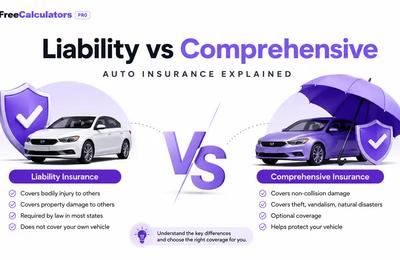
What's the difference between liability and full coverage insurance? Liability covers damage you cause to others; full coverage adds comprehensive and collision coverage for damage to your own vehicle. Full coverage costs more but protects your own asset, not just others'.
Can I compare multiple insurance companies using one calculator? Some calculators provide comparative ranges across carrier types, but for exact company-specific pricing, you'll still want to request quotes directly from insurers like GEICO, Progressive, or State Farm.
How is car insurance calculated in the UK compared to the US? The core process is similar — vehicle, location, driving history, and coverage type all matter — but the UK uses third-party, third-party fire and theft, and comprehensive coverage tiers, plus a no-claims discount system that doesn't have a direct U.S. equivalent.
How can I lower my car insurance premium? Common strategies include raising your deductible, bundling policies, enrolling in a telematics/usage-based program, maintaining a clean driving record, and reviewing your coverage annually rather than letting it auto-renew.
Key Takeaways
- A car insurance calculator estimates your premium using vehicle, location, driver, and coverage inputs.
- Estimates are directional, not final — real quotes require full underwriting.
- ZIP code, driving record, and coverage type are among the biggest cost drivers.
- U.S. and U.K. calculators work similarly but use different coverage terminology.
- Calculators are especially useful before buying a car or renewing a policy.
- Telematics and AI-driven pricing models are becoming more common in both estimating tools and real underwriting.
- Comparing estimates across multiple calculators and carriers gives the most realistic picture.
- Pairing an insurance estimate with broader tools, like a life insurance calculator or savings-focused calculator, supports better overall financial planning.
Expert Summary
Car insurance pricing is driven by a combination of vehicle characteristics, driver history, location, and chosen coverage — the same variables actuarial science has used for decades, now increasingly enhanced by telematics and AI-driven risk models. An online car insurance calculator translates these variables into a usable estimate within minutes, giving consumers a practical starting point before requesting formal quotes. While not a substitute for a binding quote from a licensed carrier, a well-built calculator remains one of the most efficient tools for budgeting, comparison shopping, and understanding why premiums vary so widely between drivers.
Conclusion
Car insurance doesn't have to feel like guesswork. A reliable car insurance calculator online takes the factors real insurers use — your vehicle, your location, your driving record, and your coverage choices — and turns them into a clear, usable estimate in just a few minutes. Whether you're budgeting for a new car, renewing an old policy, or just trying to understand why your last renewal jumped, starting with an estimate puts you in a stronger position before you ever talk to an agent.
Call to Action
Ready to see your estimated cost? Try the free car insurance calculator on FreeCalculators.tools, and while you're there, explore free tools for life insurance, homeowners insurance, and retirement planning — all built to help you plan your finances with confidence, without the sales pressure.