Quick Answer
Most homeowners carry between $100,000 and $500,000 in personal liability coverage, but the right amount depends on your assets, income, and risk exposure (pools, dogs, rentals, guests). A general rule: your liability limit should be equal to or greater than your net worth. Homeowners with significant assets often pair their policy with an umbrella policy for added protection.
Introduction
If you've ever wondered what actually happens when a guest slips on your driveway or your dog nips a neighbor, you're really asking about personal liability coverage homeowners insurance policies include. This single coverage line — often bundled quietly into your policy as "Coverage E" — can be the difference between a manageable claim and a financial disaster that follows you for years. Before diving into the numbers, it helps to run your own numbers first. Tools like the homeowners insurance calculator on FreeCalculators.tools let you estimate coverage costs instantly, while the term life insurance calculator and whole life insurance calculator can help you see how liability protection fits into your broader financial safety net. If you're also weighing vehicle-related exposure, the auto insurance calculator rounds out the picture. This guide breaks down exactly how to determine the right homeowners insurance personal liability coverage for your situation — no guesswork required.
What Is Personal Liability Coverage in Homeowners Insurance?
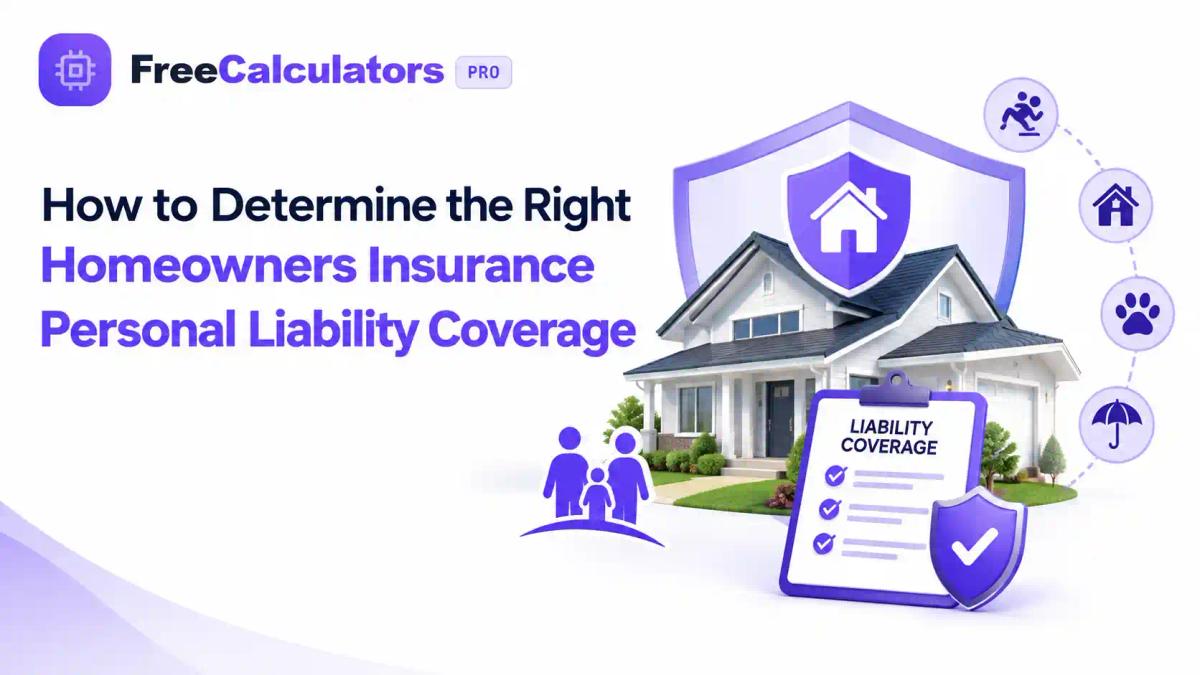
Personal liability coverage is the part of a standard homeowners insurance policy — typically labeled Coverage E — that helps pay for covered claims when you're found legally responsible for someone else's bodily injury or property damage. It generally applies both on and off your property (for example, if your dog bites someone at the park) and may also help cover certain legal defense costs if you're sued, subject to your policy's terms, exclusions, and limits.
This coverage sits alongside, but is distinct from, your dwelling and personal property coverage. While those protect your stuff, personal liability protects your finances when someone else's injury or loss is deemed your fault.
How Does Homeowners Personal Liability Insurance Work?
When a covered liability claim is filed against you — say, a visitor is injured on your steps — your insurer typically investigates the claim, negotiates or defends against it, and pays out damages up to your policy's limit if you're found liable. Anything above that limit generally becomes your personal financial responsibility, which is why understanding your homeowners insurance liability limits matters so much.
Coverage usually applies per occurrence, meaning each separate incident is measured against your chosen limit. This is why insurance professionals and organizations like the National Association of Insurance Commissioners (NAIC) encourage homeowners to periodically review whether their limits still make sense as their assets and lifestyle change.
How Much Personal Liability Coverage Do Homeowners Need?
There's no single number that fits everyone, but most insurers offer standard personal liability coverage limits of $100,000, $300,000, and $500,000, with higher limits or umbrella add-ons available for homeowners with more exposure.
A widely used starting framework is:
Liability Coverage Need = Asset Exposure + Risk Exposure + Legal Exposure
- Asset Exposure — home equity, savings, investments, and other property that could be pursued in a judgment
- Risk Exposure — pools, trampolines, dogs, rental units, frequent visitors, or multiple properties
- Legal Exposure — the potential size of injury claims, property damage claims, and legal-defense costs in your area
Running your numbers through the homeowners insurance calculator is a practical first step to see how different liability limits affect your premium before you call an agent.
Factors That Determine Your Liability Coverage Needs
Your Personal Assets
The more you own — home equity, brokerage accounts, retirement savings, a second property — the more a lawsuit could put at risk. A common guideline is to carry liability coverage at least equal to your total net worth.
Your Income and Financial Exposure
Higher earners are often considered more attractive litigation targets, and future wages can sometimes be pursued through wage garnishment following a judgment, making adequate coverage especially important.
Property-Related Risks
Certain physical features of your home — stairs, uneven walkways, or older structures — can raise the likelihood of an accidental injury on your property.
Pets and Dog-Bite Risk
Dog bite liability claims are among the most common homeowners liability claims nationally. If you own a dog, especially a larger breed, insurers may ask about bite history or breed restrictions.
Swimming Pools and Trampolines
Pools and trampolines are considered "attractive nuisances" in insurance and legal terms — they draw children and guests, and increase the odds of an accidental injury claim. Homeowners with either typically benefit from higher liability limits.
Rental or Home-Based Business Activities
If you rent out a room, a vacation home, or run a business from your house, standard homeowners liability coverage may not fully apply, and you may need a specific endorsement or separate policy.
Common Homeowners Personal Liability Coverage Limits
| Liability Limit | Potential Use |
| $100,000 | Basic liability protection |
| $300,000 | Common, higher protection level |
| $500,000 | Greater protection for higher exposure |
| $1 million+ | Often considered with significant assets or exposure, usually paired with umbrella coverage |
These figures are illustrative only — actual availability and pricing depend on your insurer, state, property, and individual circumstances.
Is $300,000 Personal Liability Coverage Enough?
For many homeowners with moderate assets and average risk factors, $300,000 is a reasonable middle ground. However, it may fall short if you have a pool, own rental property, carry significant savings or investments, or live in an area with historically higher jury awards. In those cases, $500,000 or an umbrella policy is often worth exploring.
When Should You Consider $500,000 or More?
Consider a higher personal liability insurance limit if any of the following apply to you:
- Your net worth exceeds $300,000
- You own a pool, trampoline, or other higher-risk feature
- You frequently host guests, parties, or short-term renters
- You own a dog with no bite history restrictions from your insurer
- You have significant future earning potential that could be garnished in a judgment
Homeowners Insurance vs Umbrella Insurance
Umbrella insurance is a separate policy that extends liability protection beyond the limits of your homeowners (and auto) policy — often in increments of $1 million. It typically requires you to carry a minimum underlying liability limit on your homeowners policy (commonly $300,000) before it kicks in. For homeowners with meaningful assets, pairing standard homeowners liability coverage with an umbrella policy is one of the more cost-effective ways to close a potential coverage gap. Consumer resources from organizations like the Consumer Financial Protection Bureau (CFPB) and NAIC offer additional guidance on comparing these options.
What Personal Liability Coverage Usually Covers
- Bodily injury to guests or third parties on or off your property
- Property damage you or your family accidentally cause to someone else
- Legal defense costs for covered claims, subject to your policy terms
- Certain dog bite and pet-related liability claims (insurer-dependent)
What Personal Liability Coverage Usually Does Not Cover
- Injuries to you or household members
- Business-related liability without a specific endorsement
- Intentional acts or criminal conduct
- Liability related to certain high-risk vehicles (boats, ATVs) unless specifically included
- Claims exceeding your policy's stated limit
Always review your specific policy's exclusions, since coverage details vary by insurer and state.
Best Free Tools to Estimate Your Coverage Needs
Running the numbers before you talk to an agent puts you in a much stronger negotiating position. FreeCalculators.tools offers several free resources that pair well with liability planning:
- Homeowners Insurance Calculator — estimate premiums across different coverage levels
- Life Insurance Calculator — see how liability protection fits your broader estate and financial plan
- Term Life Insurance Calculator — plan income replacement alongside asset protection
- Auto Insurance Calculator — compare liability exposure across your home and vehicle policies
- Reverse Mortgage Calculator — useful for homeowners evaluating equity and asset exposure
- FIRE Calculator — for those assessing long-term net worth against liability risk
Using these tools together gives you a fuller financial picture before you commit to a specific liability limit.
Common Mistakes Homeowners Make With Liability Coverage
- Assuming the state minimum is enough. Standard limits are a starting point, not a personalized recommendation.
- Ignoring net worth growth. As savings and equity grow, liability needs often grow too — but policies rarely update automatically.
- Overlooking pools, trampolines, and pets when calculating risk exposure.
- Skipping umbrella insurance even when assets clearly exceed the homeowners liability limit.
- Not reviewing coverage annually, especially after major life or financial changes.
- Confusing liability coverage with property or dwelling coverage.
Practical Examples
Example 1: A homeowner with $250,000 in assets, no pool, and no pets carries $300,000 in liability coverage — likely a reasonable fit for their exposure.
Example 2: A homeowner with $700,000 in combined assets, a backyard pool, and a large dog breed carries only $100,000 in liability coverage — a potential gap worth addressing with a higher limit or umbrella policy.
Example 3: A homeowner renting out a guest cottage discovers their standard policy doesn't extend liability coverage to renters, requiring a specific endorsement.
Future Trends in Homeowners Liability Coverage
- AI-powered coverage recommendations that analyze your assets and risk profile in real time
- Personalized liability risk scoring based on property data and location
- Automated annual coverage reviews triggered by life changes like home renovations or new pets
- Smart-home integration feeding risk data (pool sensors, security systems) directly to insurers
- Growing attention to short-term rental and home-based business liability as more homeowners monetize their properties
Frequently Asked Questions
How much personal liability coverage do I need?
It depends on your net worth, income, and risk factors like pools, pets, and rental activity. A common guideline is to carry liability coverage at least equal to your total net worth, with umbrella insurance for additional protection.
Is $300,000 liability coverage enough?
For many moderate-asset homeowners, yes. But if you have a pool, rental property, or significant savings, $500,000 or an umbrella policy may offer better protection.
Is $500,000 liability coverage better than $300,000?
It offers a larger buffer against costly claims and is often recommended for homeowners with higher assets or risk exposure, though the added premium cost should be weighed against your specific situation.
Does homeowners insurance cover lawsuits?
Yes, covered liability claims typically include legal defense costs up to your policy limit, though coverage depends on the nature of the claim and your policy's exclusions.
Does homeowners insurance cover dog bites?
Many policies do cover dog bite liability claims, but some insurers exclude specific breeds or require additional underwriting. Always confirm with your carrier.
Does having a pool increase my liability coverage needs?
Yes, pools are considered higher-risk features that can increase the likelihood of an injury claim, so many homeowners with pools opt for higher liability limits.
Do I need umbrella insurance?
If your assets exceed your homeowners liability limit, or you have elevated risk factors, an umbrella policy can provide affordable extra protection above your existing limits.
What happens if a claim exceeds my liability limit?
Any amount above your policy's limit generally becomes your personal financial responsibility, which is why matching coverage to your actual asset exposure matters.
Can I increase my liability coverage at any time?
In most cases, yes — homeowners can typically request a higher liability limit or add an umbrella policy during their policy term or at renewal.
Is there a calculator to estimate my liability coverage needs?
Yes, the homeowners insurance calculator on FreeCalculators.tools lets you compare coverage levels and estimated costs in minutes.
Key Takeaways
- Personal liability coverage (Coverage E) helps protect your finances if you're found legally responsible for someone else's injury or property damage.
- Standard limits range from $100,000 to $500,000, with higher limits available.
- A practical guideline: carry liability coverage at least equal to your net worth.
- Pools, trampolines, dogs, and rental activity all increase your risk exposure.
- Umbrella insurance extends protection beyond your homeowners policy's limit.
- Coverage typically excludes intentional acts, business activity, and claims beyond your limit.
- Reviewing your coverage annually helps keep it aligned with your growing assets.
- Free tools like the homeowners insurance calculator make it easy to compare coverage options before speaking with an agent.
Expert Summary
Choosing the right personal liability coverage for your homeowners insurance comes down to matching your policy limit to your actual financial exposure — not simply picking a default number. Homeowners should weigh their net worth, income, property risks (pools, pets, rentals), and potential legal costs when selecting a limit, and consider umbrella insurance once assets exceed standard homeowners limits. Because policies, exclusions, and state rules vary, reviewing coverage annually and using tools to model different scenarios helps homeowners make informed, personalized decisions rather than relying on generic advice.
Conclusion
Personal liability coverage isn't the most exciting part of homeowners insurance, but it's one of the most financially important. Taking a few minutes to assess your assets, risks, and legal exposure can save you from a costly gap down the road. Whether you're deciding between $300,000 and $500,000, or wondering if an umbrella policy makes sense, the smartest first step is running your numbers.
Ready to see where you stand? Explore the full suite of free tools at FreeCalculators.tools to plan your coverage with confidence — start with the homeowners insurance calculator, pair it with the life insurance calculator, term life insurance calculator, whole life insurance calculator, auto insurance calculator, car insurance calculator, reverse mortgage calculator, FIRE calculator, college savings calculator, and 529 calculator to build a complete financial picture. Browse more guides on the blog, including How Much Term Life Insurance Do You Need in 2026, learn more about us, check out our services, or contact us with your questions. If you'd like personalized guidance on structuring your homeowners liability coverage, Book a Seat with our planning resources today and take the guesswork out of protecting what you've built.