Quick Answer
A clean driving record auto insurance discount is calculated by multiplying your eligible premium by the discount percentage your insurer offers, typically 5% to 25% depending on your state, insurer, and years without accidents or violations. Formula: Discount Savings = Eligible Premium × Discount Rate. Actual savings vary by company, state regulations, and your full driver profile.
Introduction
If you've gone years without a ticket, a fender-bender, or an at-fault accident, you've probably wondered exactly how much that clean driving record is worth. Insurance companies reward safer drivers, but the math behind a good driver discount isn't always spelled out clearly on a renewal notice. Understanding how insurers calculate a clean driving record auto insurance discount can help you budget more accurately, negotiate with your carrier, and plan your broader finances with confidence. If you're already thinking ahead about your household budget, tools like a budget calculator or an auto insurance calculator on FreeCalculators.tools can help you see exactly where those savings fit into your monthly plan. This guide walks through the formula insurers use, a worked example, the factors that move the needle, and why a clean record doesn't always mean a cheap premium. Along the way, you'll also find quick links to a car insurance calculator and a life insurance calculator for readers looking to plan their full insurance picture, not just their auto policy.
What Is a Clean Driving Record?
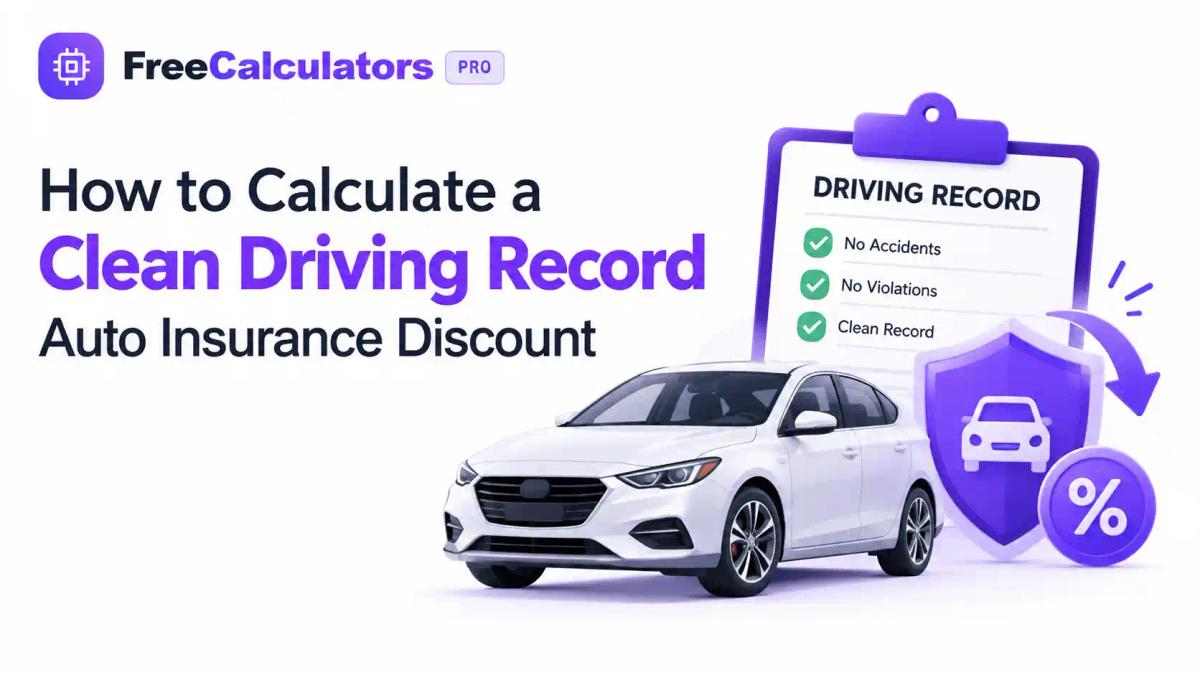
A clean driving record generally means a driver's history free of at-fault accidents, moving violations, DUI/DWI convictions, and license suspensions over a defined lookback period — commonly three to five years, though this varies by insurer and state. Your motor vehicle record (MVR), maintained by your state's Department of Motor Vehicles, is the official document insurers pull to verify this history during underwriting.
It's worth noting that "clean" is relative. A single parking ticket usually won't count against you, but a speeding ticket, an at-fault collision, or a reckless driving citation typically will. Insurers define the exact lookback window and qualifying violations differently, which is why the same driver might qualify for a discount with one company and not another.
What Is a Good Driver Auto Insurance Discount?
A good driver discount — sometimes called a safe driver discount — is a price reduction applied to your base premium when you meet an insurer's criteria for low-risk driving behavior. The core logic follows a simple relationship:
Clean Driving Record → Lower Perceived Risk → Good/Safe Driver Discount → Potential Premium Savings
This discount reflects actuarial data: drivers with fewer violations and accidents statistically file fewer claims, so insurers price their risk lower. Major carriers such as State Farm, GEICO, Progressive, Allstate, USAA, Liberty Mutual, Nationwide, American Family, and Farmers all offer some version of this discount, though eligibility rules and percentages differ.
How to Calculate a Clean Driving Record Insurance Discount
The Basic Formula
The core calculation is straightforward:
Discount Savings = Eligible Premium × Discount Rate
Then:
Discounted Premium = Eligible Premium − Discount Savings
Example Calculation
Let's say your annual eligible premium is $1,500, and your insurer offers a 10% good driver discount based on your clean record.=
| Item | Example |
| Annual premium | $1,500 |
| Good driver discount | 10% |
| Annual savings | $150 |
| Premium after discount | $1,350 |
$1,500 × 0.10 = $150 in annual savings, bringing your discounted premium to $1,350 per year. This is an illustrative calculation — actual discount percentages and eligible premium amounts vary by insurer, state, and individual driver profile.
How to Calculate Monthly Savings
To see the impact on a monthly payment, simply divide the annual figures by 12:
$150 ÷ 12 = $12.50 in monthly savings, bringing a $125/month premium down to roughly $112.50/month.
If you want to run your own numbers without manual math, an auto insurance calculator can help you model different discount percentages against your actual premium, and a loan calculator can help if you're financing the vehicle itself and want to see how insurance costs fit into your total monthly outlay.
What Factors Determine Your Good Driver Discount?
Several underwriting factors influence the size of your discount:
- Accident history — at-fault accidents typically reduce or eliminate eligibility
- Traffic violations — speeding tickets, reckless driving, and moving violations count against you
- Length of clean driving history — three, five, or ten years of a clean record often unlocks higher tiers
- State insurance regulations — some states cap or standardize how discounts are applied
- Insurer-specific underwriting rules — every carrier weighs risk factors differently
- Claims history — a claims-free record is related to, but not identical to, a violation-free record
- Driver age and experience — newer or younger drivers may have limited discount eligibility regardless of a clean record
- Policy type and coverage limits — full coverage versus liability-only policies can affect discount structure
How Many Years of Clean Driving Do You Need?
Most insurers require three to five consecutive years without an at-fault accident or major violation to qualify for a standard good driver discount, though some programs offer smaller discounts after just one claims-free year and larger discounts at the five- or ten-year mark. A driver with a decade of violation-free history may see a meaningfully larger discount than one with three years, since insurers view sustained safe behavior as a stronger risk indicator.
Do Accidents or Tickets Affect the Discount?
Yes. A single at-fault accident or a serious moving violation can reduce or completely remove your good driver discount at your next renewal, even if the rest of your history is clean. Minor infractions like a single non-moving violation (such as a parking ticket) typically don't count, but speeding tickets, DUI/DWI convictions, and at-fault collisions almost always do. Insurers reassess your motor vehicle record at each renewal period, so a recent violation can undo years of accumulated discount eligibility.
Why Is Your Insurance Still Expensive With a Clean Record?
This is one of the most common points of confusion, and it deserves a clear answer: a clean driving record does not guarantee a low premium. Your good driver discount is applied to a base premium that's shaped by many other rating factors, including:
- Age and driving experience
- Geographic location and local claims trends
- Vehicle make, model, and safety rating
- Annual mileage driven
- Coverage limits and deductible chosen
- Credit-based insurance score (where legally permitted by state)
- Overall claims history, including no-fault claims
- Vehicle theft risk in your area
- Continuous insurance coverage history
Think of it as a layered process: Base premium → other rating factors → eligible discounts → final premium. A 10% good driver discount on an already-high base premium can still leave you paying more than a driver in a lower-risk area with a smaller discount. If your premium feels high despite a spotless record, it's worth requesting a full rating breakdown from your insurer, and comparing quotes using tools like FreeCalculators.tools' auto insurance calculator to see how different variables shift your estimated cost.
Good Driver Discount vs. Other Insurance Discounts
It's easy to conflate several similarly named discounts, but they're not identical:
- Good Driver Discount ≠ Claims-Free Discount — a claims-free discount focuses specifically on whether you've filed claims, regardless of fault, while a good driver discount typically focuses on violations and at-fault incidents.
- Good Driver Discount ≠ Telematics Discount — telematics or usage-based insurance (UBI) programs, such as Progressive's Snapshot, track real-time driving behavior (braking, speed, mileage) rather than historical record.
- Good Driver Discount ≠ Accident Forgiveness — accident forgiveness is a policy feature that prevents your first at-fault accident from raising your rate; it doesn't reward a clean record so much as protect against one lapse.
- Good Driver Discount ≠ Defensive Driving Course Discount — completing an approved defensive driving course can earn a separate, often smaller, discount independent of your driving history.
Understanding these distinctions helps you ask your insurer the right questions and stack eligible discounts where policies allow.
How to Get the Maximum Auto Insurance Savings With a Clean Record
- Maintain violation-free driving for as many consecutive years as possible — most tiered discount programs reward longevity.
- Enroll in a telematics program if your insurer offers one, since it can stack with a traditional good driver discount.
- Complete a defensive driving course approved by your state, which may add an additional discount layer.
- Bundle policies — combining auto with home or renters insurance often unlocks additional multi-policy discounts.
- Shop and compare annually — discount structures vary widely between State Farm, GEICO, Progressive, Allstate, and others, so the same clean record can be worth more elsewhere.
- Ask directly about discount tiers — some insurers don't automatically apply every discount you're eligible for.
- Review your full rating profile using an auto insurance calculator to understand which factors, beyond your driving record, are shaping your premium.
How to Check Your Driving Record
You can request your official motor vehicle record through your state's Department of Motor Vehicles (DMV), either online, by mail, or in person, usually for a small fee. Many insurers also provide a summary of the driving history they used during underwriting upon request. Reviewing your MVR periodically helps you catch reporting errors — such as a violation listed past its statutory expiration — that could be costing you a discount you actually qualify for.
Best Free Tools for Calculating Your Insurance Savings
Once you understand the formula behind a good driver discount, running your own numbers is the next step. FreeCalculators.tools offers a full suite of free planning tools that go beyond auto insurance:
- Auto Insurance Calculator — estimate premiums and discount impact
- Car Insurance Calculator — compare coverage scenarios
- Life Insurance Calculator — plan income replacement and death benefit needs
- Term Life Insurance Calculator — estimate term coverage costs
- Whole Life Insurance Calculator — model permanent coverage and cash value
- Homeowners Insurance Calculator — estimate bundling savings potential
- Commercial Loan Calculator — useful for business auto policies
- Basic Calculator — quick manual calculations for any discount scenario
These tools are designed to help everyday drivers and households make sense of complex insurance and financial decisions without needing a spreadsheet or a finance degree.
Common Mistakes to Avoid
- Assuming a clean record automatically lowers your rate — it only affects one component of a multi-factor premium.
- Not asking your insurer which discounts you're already receiving — some discounts require an active request.
- Ignoring state-specific rules — a discount common in California may not exist in the same form in Texas or New York.
- Letting a policy lapse — even briefly, this can reset discount eligibility with some insurers.
- Forgetting to shop around — loyalty doesn't always equal the best discount; comparing carriers annually can reveal better terms for the same clean record.
- Confusing discount types — treating a telematics discount as identical to a good driver discount can lead to unrealistic savings expectations.
Practical Examples
Example 1 — New driver with 3 years clean: A driver with a $1,800 annual premium and a 5% discount tier saves $90/year, paying $1,710.
Example 2 — Long-term clean record (10 years): A driver with a $1,600 annual premium and a 20% discount tier saves $320/year, paying $1,280.
Example 3 — Clean record but high-risk location: A driver with a spotless 7-year record but a $2,400 base premium (due to location and vehicle type) receives a 15% discount, saving $360/year, but still pays $2,040 — more than a driver elsewhere with a smaller discount on a lower base premium.
These examples illustrate why the discount percentage alone doesn't determine your final cost — the base premium matters just as much.
Future Trends in Driving-Based Insurance Discounts
Looking ahead, several developments are reshaping how insurers evaluate driving history:
- AI-assisted insurance pricing that blends traditional MVR data with real-time behavioral inputs
- Connected-car and smartphone-based telematics offering more granular risk assessment than annual record reviews
- Automated MVR verification reducing manual underwriting delays
- Personalized, usage-based insurance pricing that updates more frequently than traditional annual renewals
- Behavioral driving analytics that may eventually supplement or replace static "clean record" categories
- Growing privacy considerations around how much driving data insurers can access and use
As these technologies mature, the line between a traditional "clean driving record discount" and a dynamic, data-driven discount is likely to blur further.
Frequently Asked Questions
What is considered a clean driving record?
A clean driving record typically means no at-fault accidents, DUI/DWI convictions, license suspensions, or major moving violations within a set lookback period, usually three to five years, though minor infractions like parking tickets generally don't count against it.
How much is a good driver discount?
Good driver discounts commonly range from 5% to 25% of your eligible premium, depending on the insurer, your state, and how many consecutive years you've maintained a clean record. There's no single universal percentage across the industry.
Does a clean driving record guarantee a lower insurance rate?
No. Insurers weigh many rating factors beyond driving history, including location, vehicle type, age, credit-based insurance score where permitted, and coverage limits, so a clean record lowers risk but doesn't guarantee the lowest possible premium.
How many years of clean driving are required for a discount?
Most insurers require three to five consecutive years without an at-fault accident or major violation for a standard discount, with some offering higher discount tiers at the five- or ten-year mark.
Do speeding tickets affect good driver discounts?
Yes. A speeding ticket or other moving violation can reduce or eliminate your good driver discount at your next policy renewal, even if the rest of your driving history remains clean.
Is a telematics discount different from a good driver discount?
Yes. A telematics discount is based on real-time, observed driving behavior tracked through a device or app, while a good driver discount is based on your historical driving record — the two can sometimes be combined.
How can I check my driving record?
You can request your official motor vehicle record from your state's Department of Motor Vehicles online, by mail, or in person, often for a small fee, or ask your insurer for the driving history summary used in underwriting.
Can defensive driving courses increase my insurance savings?
Yes, in many states completing an approved defensive driving course adds a separate discount that can be combined with your existing good driver discount, though the added savings are usually modest.
Why is my insurance still expensive despite having a clean record?
Your premium reflects multiple rating factors beyond driving history — location, vehicle type, coverage limits, and credit-based insurance score where applicable — so a discount reduces your base premium but doesn't override these other cost drivers.
Can multiple driving-related discounts be combined?
In many cases, yes — a good driver discount, a telematics discount, and a defensive driving course discount can often stack, though exact combinability rules depend on your specific insurer and policy terms.
Key Takeaways
- A clean driving record discount is calculated using Discount Savings = Eligible Premium × Discount Rate
- Typical discount ranges fall between 5% and 25%, varying by insurer and state
- Most programs require 3 to 5 years of violation-free driving for standard eligibility
- A single at-fault accident or major violation can remove your discount at renewal
- A clean record lowers risk but does not guarantee the lowest overall premium
- Good driver discounts differ from telematics, claims-free, and accident forgiveness programs
- Comparing insurers annually can reveal significantly different discount structures for the same driving history
- Reviewing your official motor vehicle record helps catch errors that may be limiting your discount
Expert Summary
Calculating a clean driving record auto insurance discount starts with a simple formula — eligible premium multiplied by discount rate — but the real value depends on layered underwriting factors including state regulations, insurer-specific rules, and your complete driver profile. While good driver discounts typically range from 5% to 25%, they apply to a base premium already shaped by location, vehicle type, and coverage choices. Drivers seeking maximum savings should maintain a long violation-free history, compare insurers regularly, and use planning tools to model realistic outcomes rather than assuming a clean record alone guarantees the cheapest rate.
Conclusion
A clean driving record is one of the most valuable assets you can bring to an auto insurance renewal, but understanding exactly how insurers translate that history into dollars and cents puts you in a stronger position to negotiate, compare carriers, and plan your budget realistically. The formula is simple; the underlying factors are not — which is exactly why running your own numbers matters.
Call to Action
Ready to see exactly how your clean driving record translates into real savings? Use the free auto insurance calculator and car insurance calculator on FreeCalculators.tools to model your own discount scenarios, compare them against your current premium, and see where the savings fit into your broader financial plan. Explore related tools like the life insurance calculator, term life insurance calculator, whole life insurance calculator, homeowners insurance calculator, retirement and savings tools, college savings calculator, and 529 calculator to plan your full financial picture in one place. Visit the FreeCalculators.tools homepage, browse all available tools, check out the blog for more insurance and finance guides, learn more about us, explore our services, or contact us with your questions. If you'd like personalized guidance on maximizing your good driver discount and overall insurance strategy, Book a Seat with our planning resources today and take the next step toward smarter, more confident financial decisions.